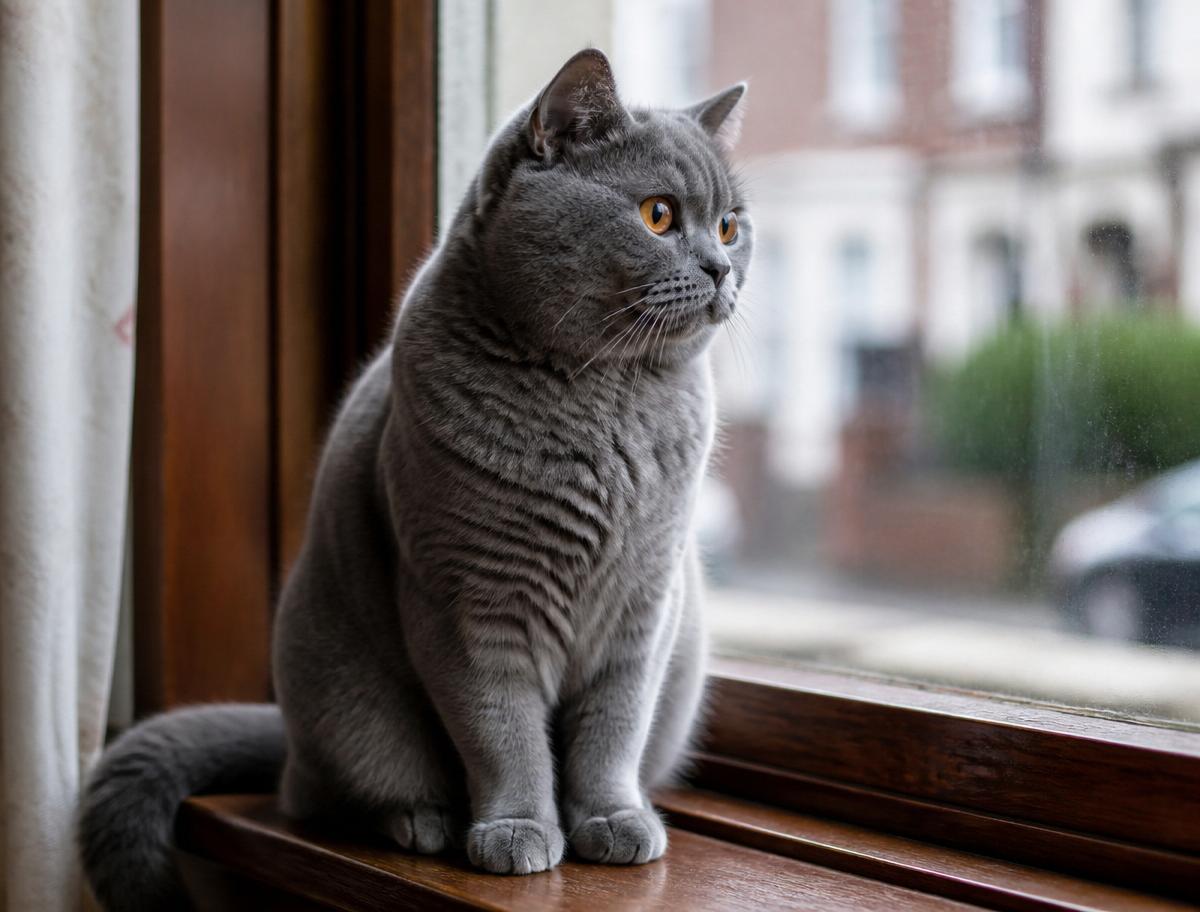
British Shorthair
History and background
The British Shorthair descends from the working cats of Roman Britain and was formally developed as a breed by Victorian cat fanciers in the late 19th century. Harrison Weir, founder of the National Cat Club, exhibited the classic blue British at the very first Crystal Palace cat show in 1871. The breed's numbers collapsed during both world wars and was rebuilt in the mid-20th century by crossing surviving lines with Persians, which gave the breed its distinctive round head, dense coat and heavier bone.
Temperament and family life
British Shorthairs are famously placid. They tolerate children and other pets well, rarely scratch or bite in play, and are happy to be admired from across the room rather than smothered. They do not tend to be lap cats — most prefer to sit beside you — and are one of the quieter breeds, meowing only when they want something specific. This makes them a good match for first-time owners, older households and flats where a noisy or high-energy cat would struggle.
Common health issues
Two conditions dominate British Shorthair veterinary care: hypertrophic cardiomyopathy (HCM), an inherited heart disease that responsible breeders screen for by DNA test and annual echocardiogram, and obesity, because the breed's low activity level makes weight gain easy. Polycystic kidney disease (PKD), inherited from the Persian outcrosses, is less common today but still worth a DNA test on the parents. Dental disease is also over-represented — expect a dental scale and polish under anaesthetic every 2–3 years.
Costs of owning a British Shorthair in the UK
Kitten prices from a GCCF-registered breeder typically run £600–£1,200 for a pet-quality blue and more for rare colours. Ongoing costs for a healthy adult sit around £70–£110 a month once you include premium food, litter, annual vaccination and parasite cover. Budget an extra £200–£400 a year for dental work as the cat ages. See our cat vaccination cost guide and dental treatment prices for what UK practices actually charge.
Insurance considerations
British Shorthairs are classed as a pedigree by most UK insurers, which pushes premiums roughly 20–40% above the moggy average. Because HCM claims can run into thousands over a cat's lifetime, a lifetime policy with at least £4,000–£7,000 of annual vet-fee cover is the sensible minimum — accident-only and 12-month policies stop paying just when heart disease usually presents.
Frequently asked questions
Are British Shorthairs good with children?
Do British Shorthairs need to go outside?
How much grooming does a British Shorthair need?
Why is my British Shorthair so heavy?
Related breeds
By The Vet Price Comparison Site editorial team · Last reviewed23 September 2026. Sources: RCVS, The Kennel Club, RVC VetCompass, ABI, and our live UK practice pricing dataset.