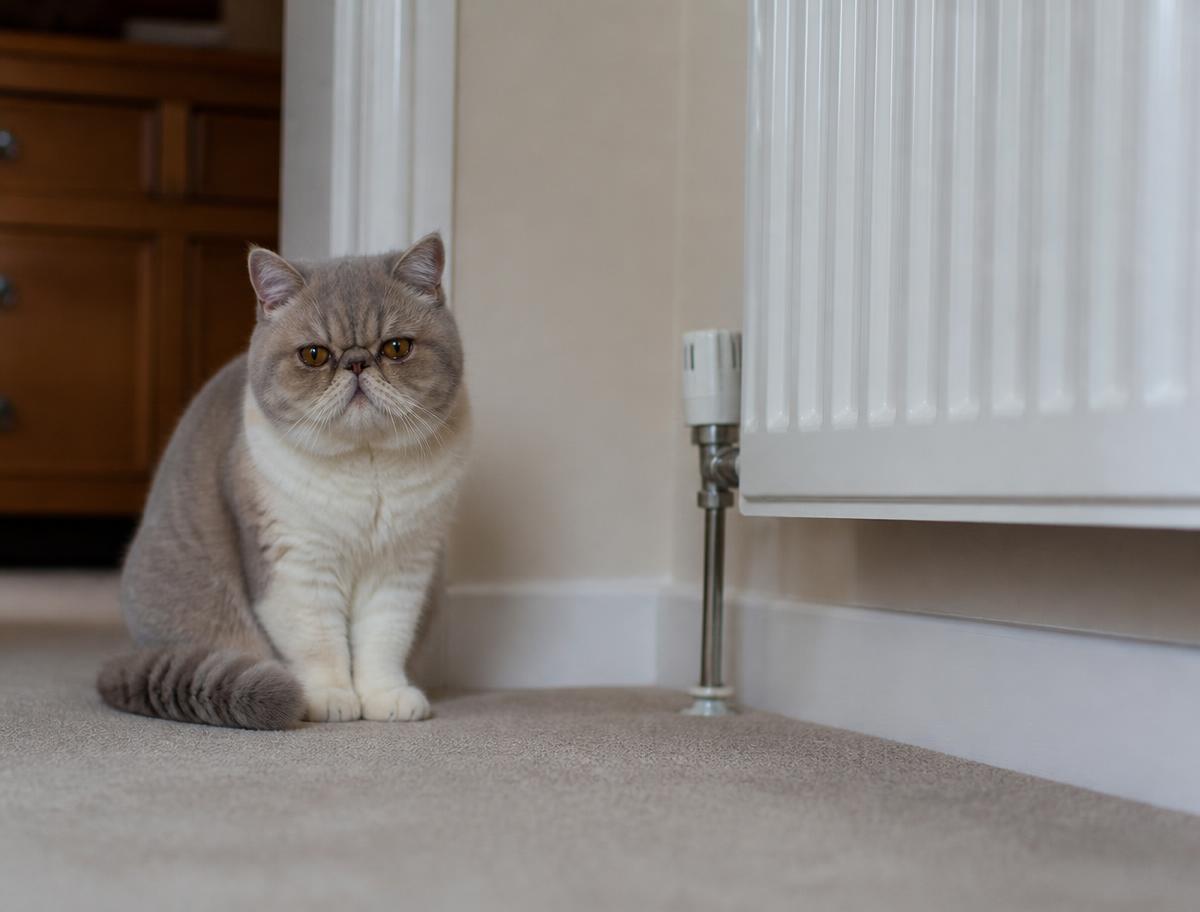
Exotic Shorthair
History and background
The Exotic began as an accident in 1950s America, when breeders crossed Persians with American Shorthairs to improve coat colour and instead produced a short-coated cat with a Persian head. It was recognised as its own breed in 1966 and reached Britain in the 1980s. Under GCCF rules Exotics can still be outcrossed to Persians, which is why the two breeds share a health profile almost exactly - and why a longhaired kitten occasionally appears in an Exotic litter.
Temperament and family life
Exotics are among the easiest cats to live with. They are quiet, affectionate, slow-moving and completely unflappable - happy to be picked up, tolerant of children and dogs, and content in a flat. They are more playful than a Persian but still spend most of the day asleep. Because they are so placid, weight gain is the standard problem; a bored, overfed Exotic reaches six kilos very easily, which makes an already-difficult airway worse.
Common health issues
Almost everything on this list comes from the flat face. Brachycephalic obstructive airway syndrome causes snoring, open-mouth breathing after mild exertion and poor heat tolerance; severe cases need surgery. The shortened tear ducts cause chronic epiphora - constant eye weeping that stains the face and needs daily cleaning - and the shallow eye sockets make corneal ulcers common after minor knocks. The compressed jaw causes dental crowding and malocclusion, so periodontal disease starts young. Separately, polycystic kidney disease runs in Persian lines and has a DNA test that every breeder should be using, and hypertrophic cardiomyopathy is over-represented. Ask specifically whether the parents were PKD-negative by DNA test rather than by scan.
Costs of owning an Exotic Shorthair in the UK
Registered kittens cost £700-£1,500. The running costs are higher than the placid nature suggests: expect annual dental attention, regular eye care, and a real possibility of airway surgery. A soft-palate and nostril procedure typically runs £900-£1,800 in the UK, a corneal ulcer repair £400-£900, and a dental with extractions £350-£700. Routine spend lands around £400-£850 a year with £70-£120 a month all in. Our adult cat cost calculator shows what practices near you actually charge for consultations, vaccinations and dentals.
Insurance considerations
Insure from day one and read the brachycephalic wording carefully - a growing number of UK insurers now exclude conditions arising from conformation in flat-faced breeds, or apply a higher excess to them. Choose a lifetime policy with at least £5,000 of annual cover, and get any snoring or eye weeping properly recorded and treated early rather than mentioned in passing, because a vague note on the history is the easiest route to a later exclusion.
Frequently asked questions
What is the difference between an Exotic Shorthair and a British Shorthair?
Do Exotic Shorthairs shed a lot?
Why do my Exotic's eyes always run?
Are Exotic Shorthairs good for first-time owners?
Related breeds
By The Vet Price Comparison Site editorial team · Last reviewed12 October 2026. Sources: RCVS, The Kennel Club, RVC VetCompass, ABI, and our live UK vet pricing index.