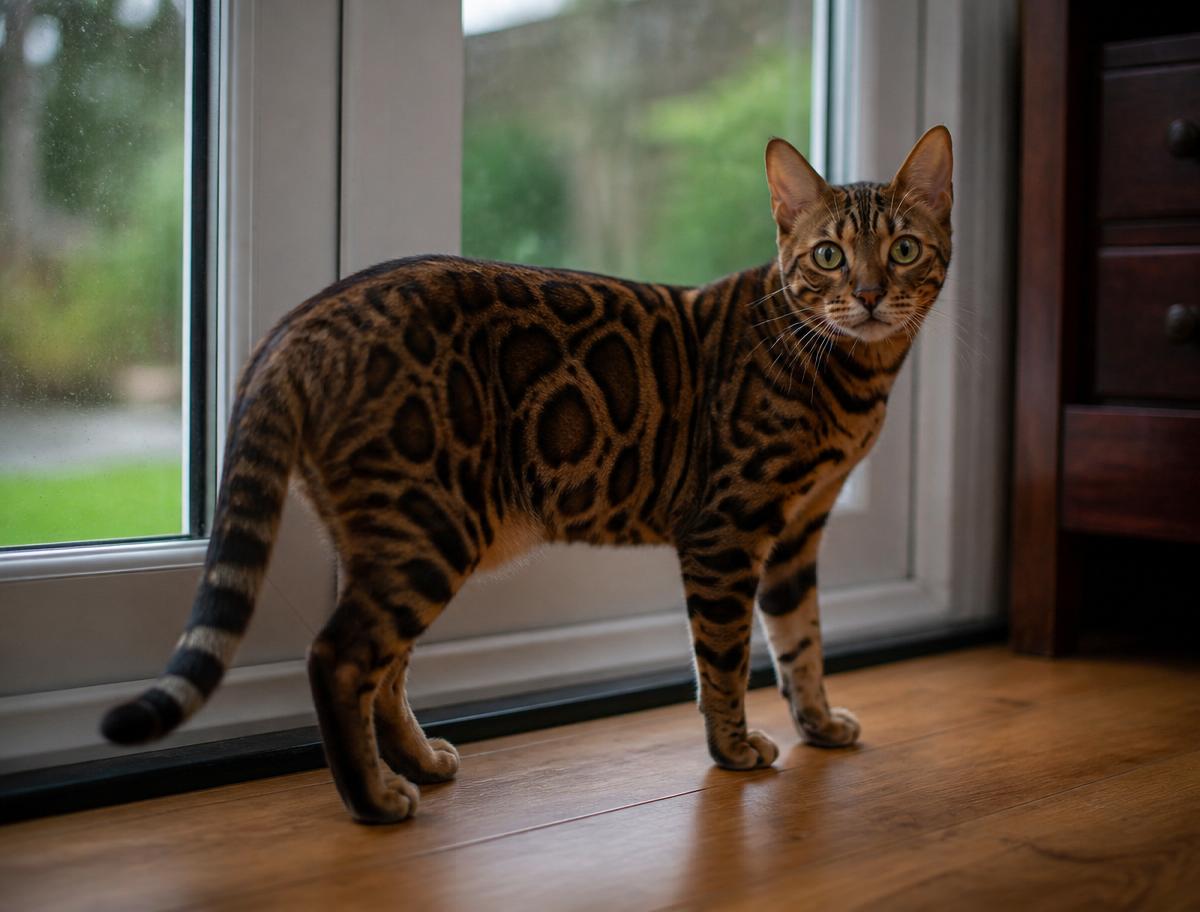
Bengal
History and background
The Bengal was developed in the United States in the 1960s and 1970s by Jean Mill, who crossed domestic cats with the Asian leopard cat to create a wild-looking but pet-tempered breed. Only cats four or more generations removed from the wild ancestor (F4 and beyond) are considered domestic Bengals in the UK, and the earlier generations (F1–F3) are subject to the Dangerous Wild Animals Act 1976 and require a licence. Any Bengal you buy from a normal UK breeder will be an F4 or later.
Temperament and family life
Bengals are demanding. They need daily interactive play, climbing structures and mental stimulation, and can become destructive or vocal if under-stimulated. They love water — many will join you in the shower — and are trainable to harness, clicker and even fetch. They can be strong-willed with other cats and are best kept as the only cat or with another Bengal. They suit active, home-based households and are not a good fit for a quiet flat with owners out all day.
Common health issues
The main inherited conditions are progressive retinal atrophy (Bengal PRA-b), DNA-testable and completely avoidable in a well-bred kitten, and pyruvate kinase deficiency (PK-Def), also DNA-testable and causing intermittent anaemia. Hypertrophic cardiomyopathy is over-represented compared to moggies, though there is no Bengal-specific DNA test yet — reputable breeders scan parents by echocardiogram. Ask for PRA-b and PK-Def certificates before you commit to a kitten.
Costs of owning a Bengal in the UK
Kittens from TICA-registered breeders typically cost £800–£1,600 depending on coat pattern and generation. Monthly all-in costs including premium food, litter, insurance and enrichment come in around £85–£125. Budget for taller cat furniture and reinforced flyscreens if you have upper-floor windows — Bengals are strong jumpers.
Insurance considerations
Bengal premiums are pushed up by breed status and by the higher rate of orthopaedic accidents from their climbing. A lifetime policy with at least £5,000 of annual vet-fee cover is sensible; check that behavioural referral is included, because Bengals with insufficient stimulation are more likely than average to need one.
Frequently asked questions
Are Bengals legal to own in the UK?
Are Bengals good family pets?
Do Bengals get on with other cats?
Do Bengals need to go outside?
Related breeds
By The Vet Price Comparison Site editorial team · Last reviewed23 September 2026. Sources: RCVS, The Kennel Club, RVC VetCompass, ABI, and our live UK practice pricing dataset.