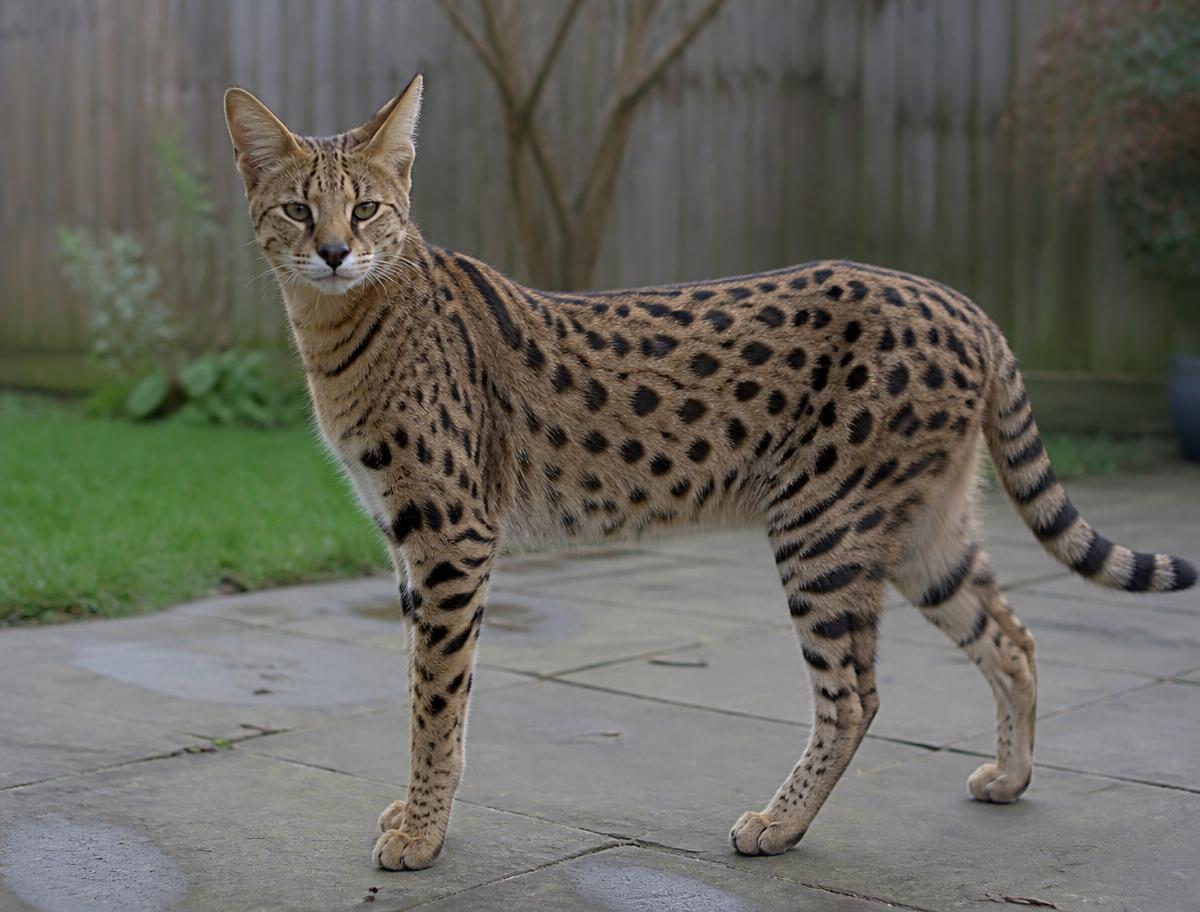
Savannah Cat
History and background
The first Savannah was born in the United States in 1986 from a serval crossed with a Siamese. Generations are labelled by how far removed the cat is from its wild ancestor: an F1 has a serval parent, an F2 a serval grandparent, and so on. Type, size and wildness all soften as the generation number rises, and by F5 the cat is essentially a large domestic shorthair with an exotic coat. The breed reached the UK in the 2000s and remains uncommon here, partly because of cost and partly because of the law.
UK law: which generations you can keep
This is the first thing to check. Under the Dangerous Wild Animals Act 1976, F1, F2 and F3 Savannahs require a licence from your local authority, which involves inspection, specified enclosure standards and public liability insurance, and can be refused. F4 and later generations do not need a licence and are the only versions most UK homes can realistically keep. Import rules are also stricter than for ordinary pedigree cats, and some rented and leasehold properties prohibit them outright. Confirm the generation in writing before any money changes hands - misrepresented F3s sold as F4s are a known problem.
Temperament and what they need
Savannahs are dog-like: they fetch, walk on a harness, learn commands, jump well over two metres from standing and often love water. They bond intensely with one household and can be reserved with strangers. What they are not is a low-maintenance cat. A Savannah needs a secure cat-proofed garden or a catio, tall climbing structures, daily active play and a home where a cat leaping onto the top of a door frame is not a crisis. They are usually a poor match for homes with very small children or with timid resident cats, and they should never be allowed to free-roam - both for wildlife reasons and because of their value to thieves.
Health and costs in the UK
Later-generation Savannahs are generally robust, with hypertrophic cardiomyopathy the main inherited concern and pyruvate kinase deficiency worth DNA testing where Bengal lines are in the pedigree. Two practical points matter more day to day: some hybrids have a shorter intestinal tract and do poorly on low-quality dry food, and a small number react badly to ketamine-based anaesthetics, so tell your practice the cat is a hybrid before any procedure. Purchase prices are steep - £1,500-£3,000 for an F4 or F5, and far more for licensed early generations. Running costs are driven by food and containment: a raw or high-meat diet, plus a catio at £1,500-£4,000 to build. Routine veterinary spend is £400-£800 a year. Our adult cat cost calculator prices consultations, vaccinations and dentals using live figures from practices near you.
Insurance considerations
Standard cat policies frequently exclude hybrid breeds, so check before you buy rather than after. You will usually need a specialist exotic or hybrid insurer, and premiums reflect both the cat's value and the theft risk. Choose a lifetime policy, make sure it includes theft and straying cover at the purchase price, and confirm third-party liability if you hold a Dangerous Wild Animals Act licence, as councils require it as a condition.
Frequently asked questions
Are Savannah cats legal in the UK?
How big do Savannah cats get?
How much does a Savannah cat cost in the UK?
Can a Savannah cat go outside?
Related breeds
By The Vet Price Comparison Site editorial team · Last reviewed12 October 2026. Sources: RCVS, The Kennel Club, RVC VetCompass, ABI, and our live UK vet pricing index.