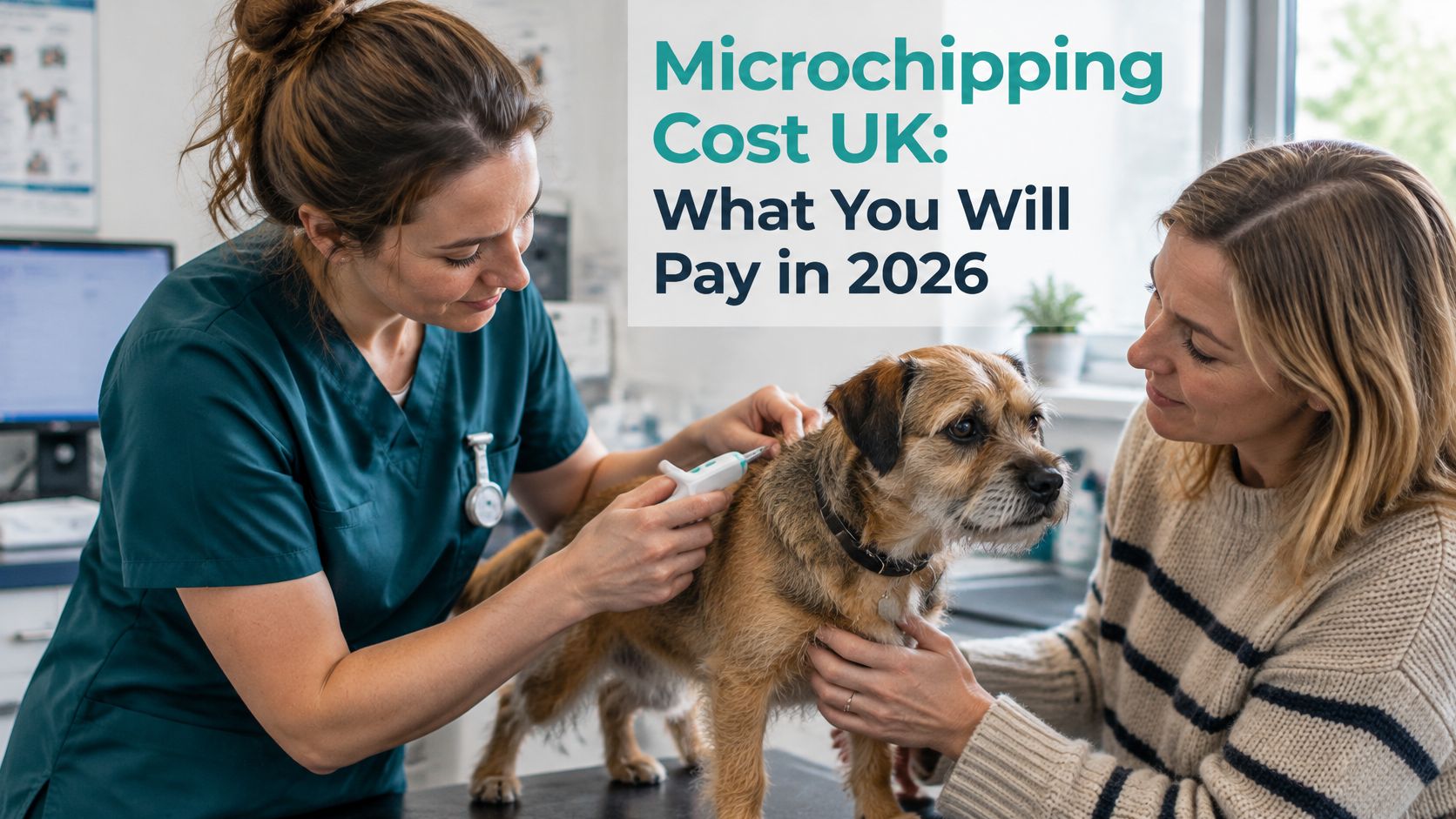
What does a microchipping quote include? Listed fees vary between practices, and a headline price does not show whether database registration is included.
An implant-only appointment can leave you with a chip but no registered record to help reunite you with your pet. Compare the itemised quote, including the implant and database registration, before deciding which option costs least.
The lowest compliant total depends on what each quote includes. Check the rules for your nation and your pet's species before booking, especially where a rule needs confirmation.
Table of Contents
- Legal Microchipping Rules Across the Four Nations
- What a Microchip Quote Actually Covers
- Why Local Microchipping Prices Vary So Much
- Free and Low-Cost Microchipping Routes Compared
- Comparing Local Practice Fees With a Postcode Search
- Confirm the Cheapest Compliant Option Before You Book
Legal Microchipping Rules Across the Four Nations
Which deadline applies depends on where you live and whether you keep a cat or a dog. England's rules set clear age limits: cats, including indoor cats, must be microchipped by 20 weeks; dogs by eight weeks. The keeper must also ensure the chip is registered on an authorised database and keep the contact details accurate.
The Arun District Council's microchipping guidance says that if an animal is found without the required chip, the keeper can receive a notice to comply within 21 days. Ignoring the notice may lead to a fine of up to £500. For a dog, an authorised person may also seize the animal and arrange microchipping at the owner's expense. Booking in advance gives you time to compare compliant options before a notice sets a deadline.
What each nation row actually settles
| Nation | Cats | Dogs | Penalty for non-compliance |
|---|---|---|---|
| England | Microchipped by 20 weeks, including indoor cats | Microchipped by 8 weeks | Fine up to £500 after a 21-day notice |
| Scotland | Check the official Scottish government guidance or ask your local council for the applicable rule | Microchipping required; keeper updates the record when ownership changes | Fine up to £500 for incorrect details |
| Wales | Check the official Welsh government guidance or ask your local council for the applicable rule | Check the official Welsh government guidance or ask your local council for the applicable rule | Check the official Welsh government guidance or ask your local council |
| Northern Ireland | Check the official Northern Ireland government guidance or ask your local council for the applicable rule | Check the official Northern Ireland government guidance or ask your local council for the applicable rule | Check the official Northern Ireland government guidance or ask your local council |
Scotland's dog requirement is framed around microchipping and keeping the record current, rather than the same age cutoff stated for England. For Wales and Northern Ireland, check the relevant nation's official government guidance or ask your local council about the cat rule, dog rule and penalty before booking. Do not assume that an English deadline applies elsewhere.
When the keeper changes
In Scotland, a new dog keeper should update the microchip record with their own details as soon as possible. The previous keeper should provide the microchip number and the name of the database holding the record. Keeping those details accurate remains part of the keeper's responsibility after the clinic visit.
Practical rule: Arrange the required chip and database record before the applicable deadline.
For a dog entering the UK, Passpaw's guide to UK dog travel covers the entry steps owners may need to organise, including the microchip record. If you are budgeting for a puppy, include microchipping alongside vaccinations and other routine care in the first-year costs; the new puppy first-year costs guide sets out those expenses.
What a Microchip Quote Actually Covers
What does a microchip quote buy you? The total depends on whether it covers only the implant or also the consultation and database registration.
| Service bundle | What it covers |
|---|---|
| Chip implantation only | Microchip and insertion |
| Implantation with database registration | Chip, insertion and initial owner record |
| Consultation-linked microchip visit | Implantation plus consultation fee |
| Detail update after moving or change of owner | Amended owner record |
Compare quotes that cover the same work. One practice's “microchip” fee may cover implantation alone; another's higher price may include the first owner record or a consultation. Ask the practice to itemise the total before comparing.
Five lines worth naming on the phone
Chip and implantation. Ask whether the price covers the device and insertion only. If the receptionist cannot split the fee, request an itemised quote.
Database registration. This links the chip number to your details. Ask whether registration is included, whether the fee is lifetime or renewable, and whether a separate invoice will follow.
Consultation on top. Some practices require a consultation for the procedure. Ask for the full appointment cost, not just the chip price.
Later amendments. A move, new phone number or change of owner may mean updating the record. Ask whether that update costs extra.
Promotions and plans. A puppy-clinic offer or health-plan rate may expire or require a plan you would not otherwise buy. Ask for the standard total after the offer ends. If you already want the plan for vaccines and worming, the reduced chip price may suit you. If not, include a year of plan fees in your comparison.
Ask for an ISO-compliant FDX-B chip operating at 134.2 kHz. The BSAVA microchipping and scanning advice identifies ISO-compliant FDX-B chips and standardised implantation sites for dogs and cats. In England, the Microchipping of Cats and Dogs (England) Regulations 2023 require a unique number containing the manufacturer code, compliance with ISO 11784 and ISO 11785, and the FDX-B protocol at that frequency. Implantation must be carried out by a veterinary surgeon, a veterinary nurse under a veterinary surgeon's direction, or another authorised person under the stated supervision. A chip that a standard scanner cannot read is a false economy.
Small mammals, equines and livestock may involve different chips, databases and legal requirements. Confirm the species and ask the practice what it implants and where the record is held.
A four-step total, not a headline
- List each quote's fees under the five headings above.
- Mark any missing fee. A blank is not a zero.
- Ask the practice to price any missing registration or consultation.
- Compare the resulting totals, not the original stickers.
An implant-only fee is not comparable with a higher price that already includes registration and a consultation.
The guide to veterinary pricing transparency rules explains why it helps to ask for itemised fees rather than one blended figure. The lowest compliant option is the one whose total covers the required chip, implantation and record, with any consultation fee included. Confirm which rules apply in your nation before booking.
Why Local Microchipping Prices Vary So Much
Local prices move for reasons you can recognise, not because one town has invented a different chip.
Overheads. Rent, wages and on-call cover are not the same in a city hospital and a rural branch. That shows up in routine fees, including the chip.
Who owns the practice. A large group and an independent can publish different bundles for the same device. One folds admin into the implant. The other invoices the database separately.
What else is on the invoice. The chip may be a naked procedure, or it may sit inside a consultation or a health plan. The plan looks cheap only if you wanted the rest of the plan.
A county average can hide a wide gap between two towns twenty minutes apart. Use any regional figure as a starting point, not a verdict on your postcode. The same chip is quoted at different totals because practices add lines differently. One lists implantation alone. The next lists implantation with registration. Add the missing line before you decide which quote is lower. A higher headline sometimes buys you a finished record, and the lower one still has a bill to come.
The spread of routine fees is mapped in the UK vet pricing data report 2026. That context stops you treating one local sticker as "the" microchipping cost UK owners should expect. It still does not replace two quotes with the same contents.
Database mistakes can cost more than the gap between those quotes. Scottish Government guidance on dog breeding says that when a dog changes hands in Scotland, the new keeper should update the microchip record with their own details as soon as possible. Information passed to the new owner should include the dog's microchip number and the name of the database, alongside the need to add the new keeper's contact information. Keeping that entry accurate is a continuing legal responsibility. Incorrect details can attract a fine of up to £500, and giving away or selling a dog with incorrect microchip information is an offence.
That is why matching contents beats chasing a regional average. Two honest totals, built from the same lines, tell you more than a county midpoint ever will.
Free and Low-Cost Microchipping Routes Compared
A free appointment only saves money if it is available when you need it and includes the required registration. Charity clinics, council schemes and practice promotions can reduce the bill, but eligibility and appointment dates vary. Check what is included before comparing the total with a standard practice quote.
Reports from animal welfare organisations point to cost and access as barriers for some owners, while local-authority provision varies. A council scheme may be fully funded, subsidised or unavailable in your area. Confirm the current offer directly with your council rather than relying on an old poster or a neighbouring authority's scheme.
A cheap route is no help if the next session is too late. Check the appointment date before building your plan around it.
Owned cats on the England timetable include indoor cats. Feral, farm and community cats with little or no human interaction are generally exempt. The exemption is narrow: a pet does not qualify only because it rarely uses the cat flap.
| Route | Who it suits | What it usually covers |
|---|---|---|
| Rescue or charity clinic | Rescue adopters and owners on low incomes | Chip and registration at a set session |
| Council-funded scheme | Owners in areas that still run a funded programme | Fully funded or subsidised microchipping |
| Practice concession or promotion | Owners who can book a planned visit | Implantation and registration at a reduced rate |
| Standard private fee | Owners needing same-day or out-of-hours booking | Implantation, registration and any consultation as quoted |
The catches that change the total
Eligibility checks. Charity clinics and council slots may require proof of address, a qualifying benefit or adoption through the rescue. Check the criteria and bring the requested documents.
Session-only dates. A monthly clinic can be a genuine saving if a slot is available before your deadline. If it is not, a private appointment may be the practical option, with a consultation fee if one applies.
Registration in or out. A “free chip” may cover implantation only. Ask whether registration is included, discounted or charged separately. A paid registration can still make the complete job cheaper overall; an implanted chip without a record does not complete the process.
Confirm any council offer with the council before relying on it. Then ask each route for an itemised total, including implantation, registration and any consultation needed to get the chip fitted. Compare like with like: the lowest headline price is not necessarily the lowest total compliant cost. A practical guide to saving on vet bills can help you weigh a discount against the extra costs attached to an appointment. If a free slot cannot be booked in time, a paid, complete option may cost less than missing the deadline and arranging another appointment.
Comparing Local Practice Fees With a Postcode Search
A checklist only helps once it is pointed at practices you can reach.
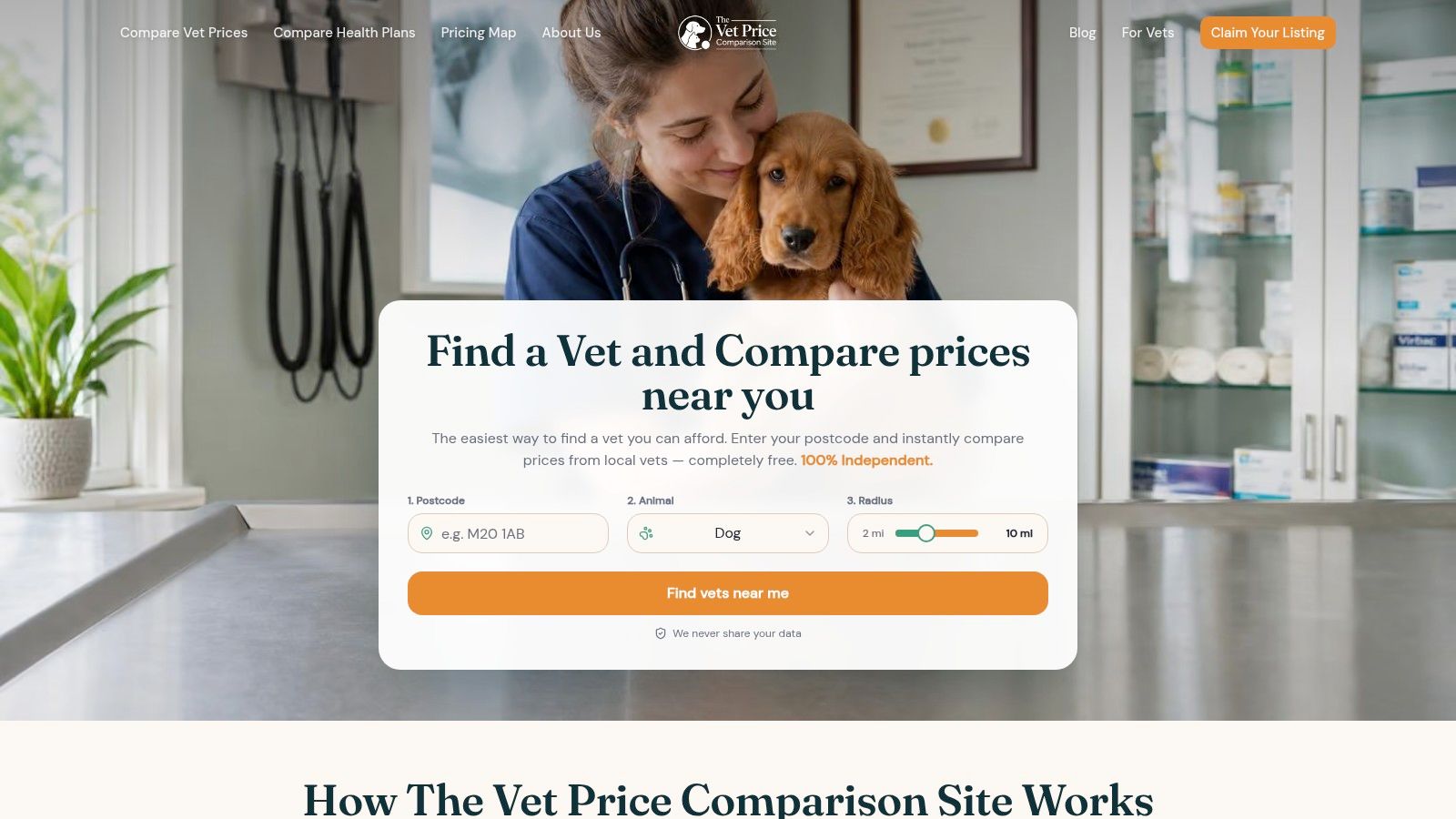
The Vet Price Comparison Site is one way to do that. You search published fees by postcode, set a distance, and read microchipping next to other routine lines. It is a shortlist tool, not a booking confirmation.
- Enter your postcode and set a distance that keeps travel realistic. A lower fee an hour away can disappear once you add fuel, parking and time off work.
- Filter to practices that treat your pet's species. Dogs, cats and small mammals are not interchangeable listings, and an exotic or equine profile will not help a kitten.
- Open the microchipping fee and decide whether it reads as a bundle or as a single chip fee. If the wording is only "microchip", treat registration as unpriced until the practice says otherwise.
- Note any line that appears only on the practice listing, such as a consultation or a registration fee, and tick it against the five-line checklist. A fee that shows up under "consultation" still belongs on the microchip total if you cannot have the chip without it.
- Compare totals across three to five practices that show the same contents. Drop any listing you cannot match. A shorter list of like-for-like prices is more useful than a long list of unlike ones.
- Save the two or three closest comparable prices. Write one line beside each about what it includes, in your own words, so you are not reconstructing the bundle from memory at the desk.
- Confirm the listed fee with the practice before you rely on it. Published listings change, offers end, and a nurse-led slot may not be the same price as a vet consult.
County context stops a single practice from looking "normal" just because it is nearest. The county pricing view shows average costs for common procedures, which tells you whether your shortlist sits high or low for the area. It is still not a personal quote.
Published fees are what practices have put on record. A short call before you book is still worth the time.
Keep the site's own published fees as the only numbers in your comparison. Do not top up a blank with a price from another website. If registration is missing, leave it missing and ask. The result you want is two or three comparable prices, each with a clear note of contents, ready to confirm in writing.
Confirm the Cheapest Compliant Option Before You Book
Start with the rule that applies to your species and your nation. Where that rule is in force, the chip is not optional. Where Wales, Northern Ireland, or the cat position in Scotland still needs a check, get that answer from the council or the official government site before you rank fees. A cheap appointment in the wrong legal frame is not a result.
Next, see whether a free or subsidised route is open to you, and whether a real date exists before you need the record. If the only session is after your deadline, it is not the lowest compliant cost. It is a discount you cannot use.
Then put two or three itemised quotes on the same lines. Pick the lowest total that includes a compliant chip and registration. Ignore the lowest headline.
Say one practice lists implantation only, and the registration fee is still unpublished on the comparison listing. A second practice lists a bundled visit. You cannot invent the missing registration charge and declare a winner. Ask both for that line in writing, add it only when they name it, and compare the finished totals. I would start there. The implant-only quote often stops looking cheap once the database fee is a real number rather than a hope. If the practice will not price the line, that quote is not ready to win.
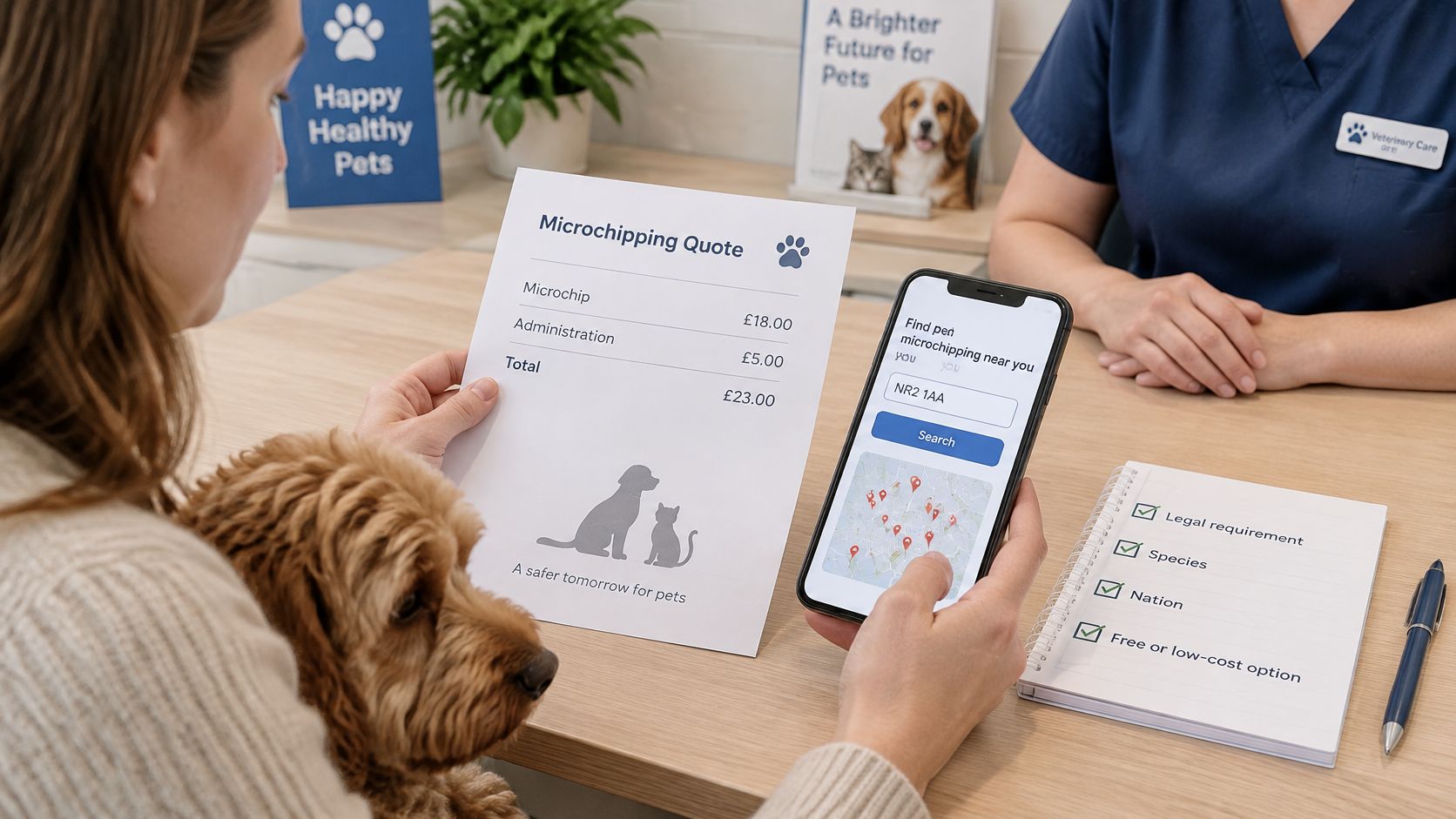
After the visit, check the paperwork the same day. The database record should show your current phone number and address, and the microchip number should appear on the clinical note or the certificate they hand you. Scan failures and typos are easier to fix before you leave the car park. Update the record whenever ownership or address changes. A perfectly placed chip with an old mobile number does not bring the animal home.
Use a postcode search to shortlist local practices, then ask the practice you prefer for a written, itemised quote before you book the slot.
The Vet Price Comparison Site brings published UK veterinary fees into one postcode search, so you can compare microchipping bundles alongside other routine care without phoning every practice first. Use it to build a like-for-like shortlist, then confirm the itemised total before you book. Visit The Vet Price Comparison Site and check the practices near you.