
Forget the popular line that a small dog means an easy dog. If you're weighing up a Jack Russell Border Terrier decision, whether that's a purebred, the other purebred, or the cross between them, size is the least useful guide you'll get. These are working terriers in compact frames. They were bred to think, chase, dig and persist. Buy one expecting a lapdog and you'll spend the next decade paying for that mistake in barking, escape attempts, training bills and stress.
Table of Contents
- Why Small Terriers Are Not Low-Commitment Dogs
- How Each Breed Earned Its Place in UK Dog Culture
- Size and Build Compared
- Temperament and Exercise Needs in Real Life
- Grooming, Health and Behaviour Triage
- What a Terrier Really Costs Across Its Life
- Choosing Between the Two for Your Situation
- Practical Next Steps Before You Commit
Why Small Terriers Are Not Low-Commitment Dogs

The useful distinction isn't cute versus scruffy. It's sprint-and-earthwork agility versus sustained endurance. The Jack Russell is described as a small, agile, active hunting terrier built to go to ground, which suits short, intense work such as scent searches, agility and rapid obstacle negotiation. The Border standard instead requires enough leg and soundness to follow a horse over varied terrain and still work underground.
That difference changes your day. A Jack Russell type usually wants frequent, high intensity engagement and serious impulse control work. A Border type is more likely to suit steady, longer rural walks and hiking. Neither profile is low exercise, and neither is automatically easier in a flat, a terrace or a family home.
What a Cross Does Not Guarantee
A Jack Russell Border Terrier cross doesn't average out neatly. You don't get half the prey drive, half the grooming and a predictable adult weight. You get a puppy who may lean towards either parent in coat, build, vocalness and intensity, and whose early experiences will shape the rest.
- Size isn't fixed: Parent measurements matter more than a breed label.
- Temperament isn't fixed: Persistence and pursuit are likely, exact expression isn't.
- Cost isn't fixed: Fees vary by postcode, practice and procedure, not by name.
Judge the dog in front of you by activity profile, not by how small he looks at eight weeks.
Plan on that basis from the start. Budget for training, secure exercise, parasite control, dental checks and activity related injuries, not just food and a lead. If you're mapping the early spend, our guide to new puppy first year costs gives you the UK cost points to price locally before you commit. That's the right order. Decide if you can run the routine and fund the care, then choose the dog.
How Each Breed Earned Its Place in UK Dog Culture
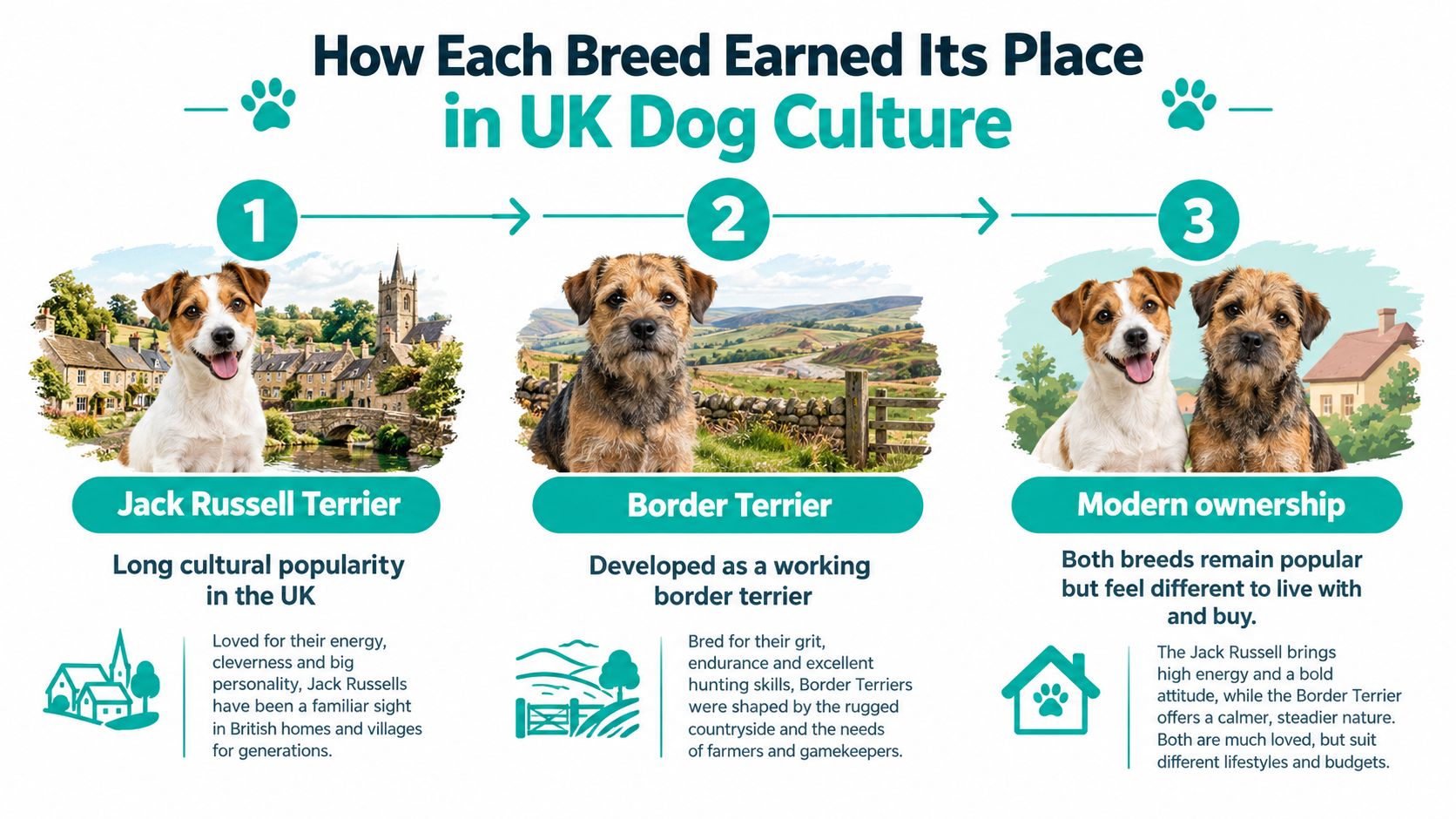
The Jack Russell's story confuses buyers because the dog feels ancient and the paperwork is new. It was developed in England in the 19th century for fox hunting, yet official recognition took effect only on 1 January 2016, with eligibility for licensed events from 1 April 2016, according to Royal Kennel Club reporting on the breed's surge in popularity. The first show for the registered breed followed on 2 April 2016.
Popularity long predated recognition. That same reporting places the Jack Russell within the UK's ten most popular breeds throughout the last century, first from 1935 to 1953, third from 2016 onward, and second in 2024. It recorded its highest ever registration figures in 2021, registrations rose by 14% between 2021 and 2022, and first quarter puppy registrations in 2025 were 75% higher than the same period in 2024.
A Different Institutional Path for the Border
The Border Terrier has deeper formal roots. It originated in the border country between Northumberland and Roxburghshire, worked alongside Border Foxhounds, and was recognised in 1920, as set out in the Midland Border Terrier Club history of the breed. Only 111 dogs were registered at recognition, rising to 659 by 1950.
Recent registered birth share has moved the other way, falling from 1.46% in 2005 to 0.78% in 2014 in UK evidence summarised in that history. Registrations describe registered births, not every pet dog in Britain, so don't overread them. They still tell you something practical about breeder availability, waiting lists and how concentrated demand can become.
If you're comparing terriers more broadly, our Staffordshire Bull Terrier breed guide shows how differently another British terrier sits in terms of build and care. For Jack Russells and Borders, the lesson is simpler. Cultural familiarity doesn't mean a breeder is reputable, and a registration boom can tighten veterinary capacity locally just when every new puppy needs vaccinations, microchipping and first checks.
Size and Build Compared
Don't buy on a generic height chart. The two standards describe size differently, and that matters if you're trying to predict a cross. The Royal Kennel Club Border Terrier breed standard gives 6 to 7 kg for dogs and 5 to 6.5 kg for bitches. By contrast, the United Kennel Club Jack Russell standard cited for comparison gives 10 to 12 inches in height and roughly 5.0 to 5.9 kg in weight.
Size and Build at a Glance
| Trait | Border Terrier | Jack Russell Terrier | Cross Expectation |
|---|---|---|---|
| Formal weight guide | 6 to 7 kg dogs, 5 to 6.5 kg bitches | Roughly 5.0 to 5.9 kg | No single guaranteed figure |
| Height guide | Functional leg to follow a horse | 10 to 12 inches mature height | Depends on parents and sex |
| Build priority | Narrow, capable of being spanned | Small, agile, built to go to ground | May lean either way |
| Coat function | Harsh outer coat, soft undercoat | Shorter working coat types vary | Ask about both parents |
| Main owner watchpoint | Body condition and endurance | Containment, recall and chase risk | Plan for both watchpoints |
Those figures describe standards, not a promise for an individual puppy. Sex, parent size and inherited traits shift the result. Ask to see and, if possible, weigh the parents. A breeder who can't give you actual measurements is asking you to guess.
Construction tells you more than kilos. The Border Terrier Club breed standard prioritises a dog who can be spanned behind the shoulder, moves in a straight and efficient way, and wears a weather resistant double coat. That is a dog built to keep going outdoors. Extra weight isn't cosmetic in that frame. It compromises flexibility and stamina.
The Jack Russell frame points the other way. Speed, alertness and underground work mean your priorities are fencing, doors, recall proofing and outlets for hunting behaviour. I've walked both types on the same lanes. The Border tends to settle into a rhythm. The Jack Russell scans every hedge like it's a job application. Plan containment and training for the dog you've got, not the average printed online.
Temperament and Exercise Needs in Real Life
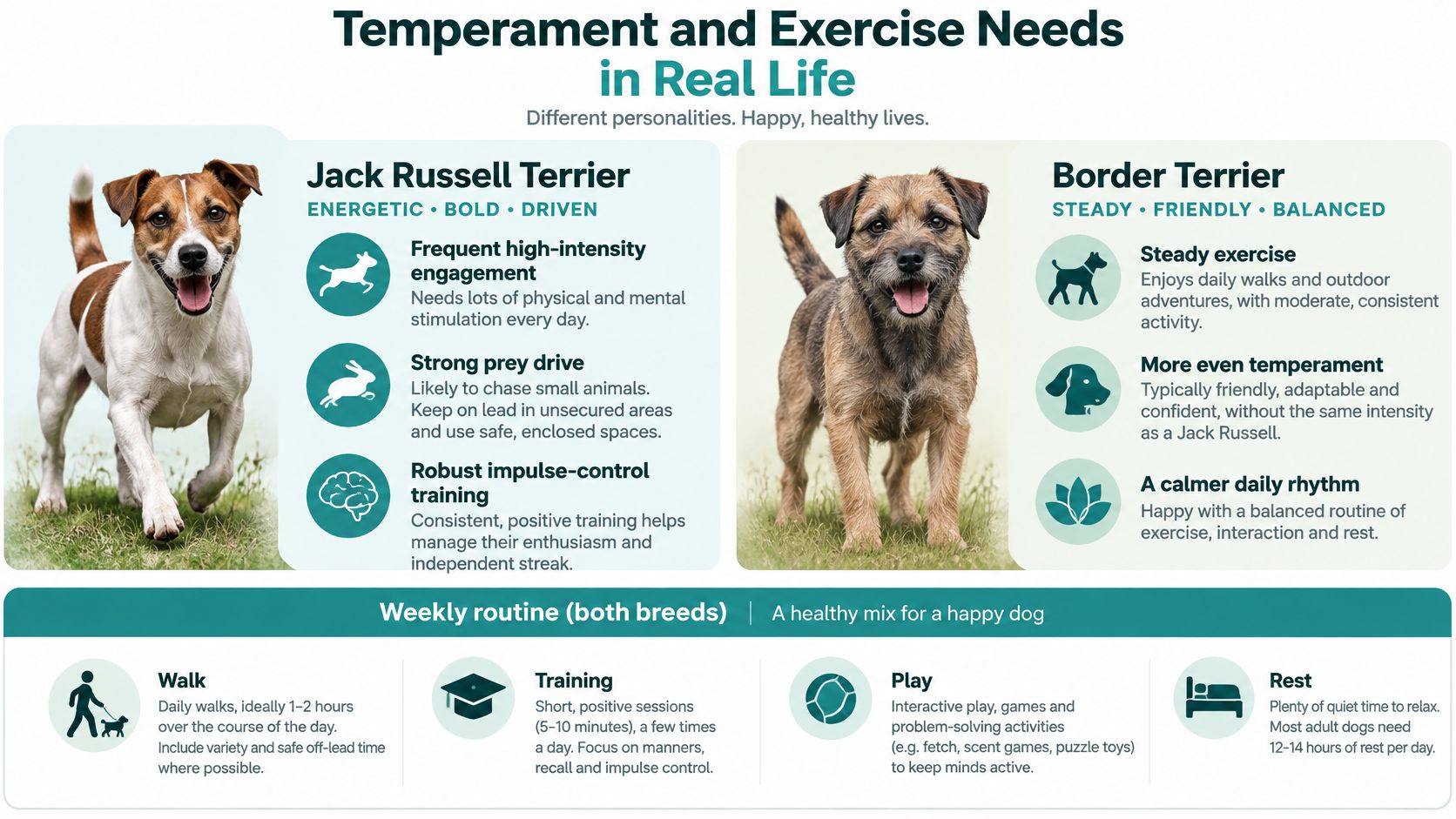
Purina UK puts typical Jack Russells at around 25 to 35 cm at the shoulder and says the shorter legged type generally needs about one hour of dedicated walking daily, with two hours not excessive for taller, sturdier types, in its Purina UK Jack Russell Terrier breed profile. That's walking on top of training, games and ordinary movement around the home. Treat one hour as a floor for a healthy adult cross, not a target to negotiate down.
The Border brief looks steadier but it isn't smaller. You're still looking at a daily working dog routine, ideally with varied terrain, sniffing time and some secure off lead freedom where recall allows. A pavement loop while you check your phone won't cut it for either breed for long.
Build the Week Around Work, Not Just Walks
- Scent work: Hide food or toys in grass, boxes and around the garden.
- Recall practice: Short, frequent, highly rewarded sessions on a long line until proofed.
- Impulse control: Wait at doors, settle on a mat, trade games with rules.
- Steady miles: Longer weekend routes suit the endurance side, built up gradually.
- Rest: Enforced downtime matters, especially for young, wired terriers.
The one line difference: Choose a Jack Russell profile for intense bursts and problem solving, a Border profile for covering ground steadily, and expect a cross to need elements of both.
Temperament follows that work history. Expect independence, quick learning and strong opinions. Terriers were often required to act without constant direction, so a dog who checks whether your cue is worth following isn't being broken. He's being a terrier. Reward based training works because it makes cooperation pay. Harsh corrections tend to create conflict with a dog bred to persist.
Be honest about prey drive. Squirrels, cats, rabbits and fast moving bikes can all switch on pursuit. Early socialisation helps a puppy learn the world is normal, but it doesn't delete hunting instinct. If you want relaxed off lead walks in sheep country from day one, choose a different kind of dog. If you enjoy training as a hobby and you will do it daily, both breeds can be superb, funny and loyal companions.
Grooming, Health and Behaviour Triage
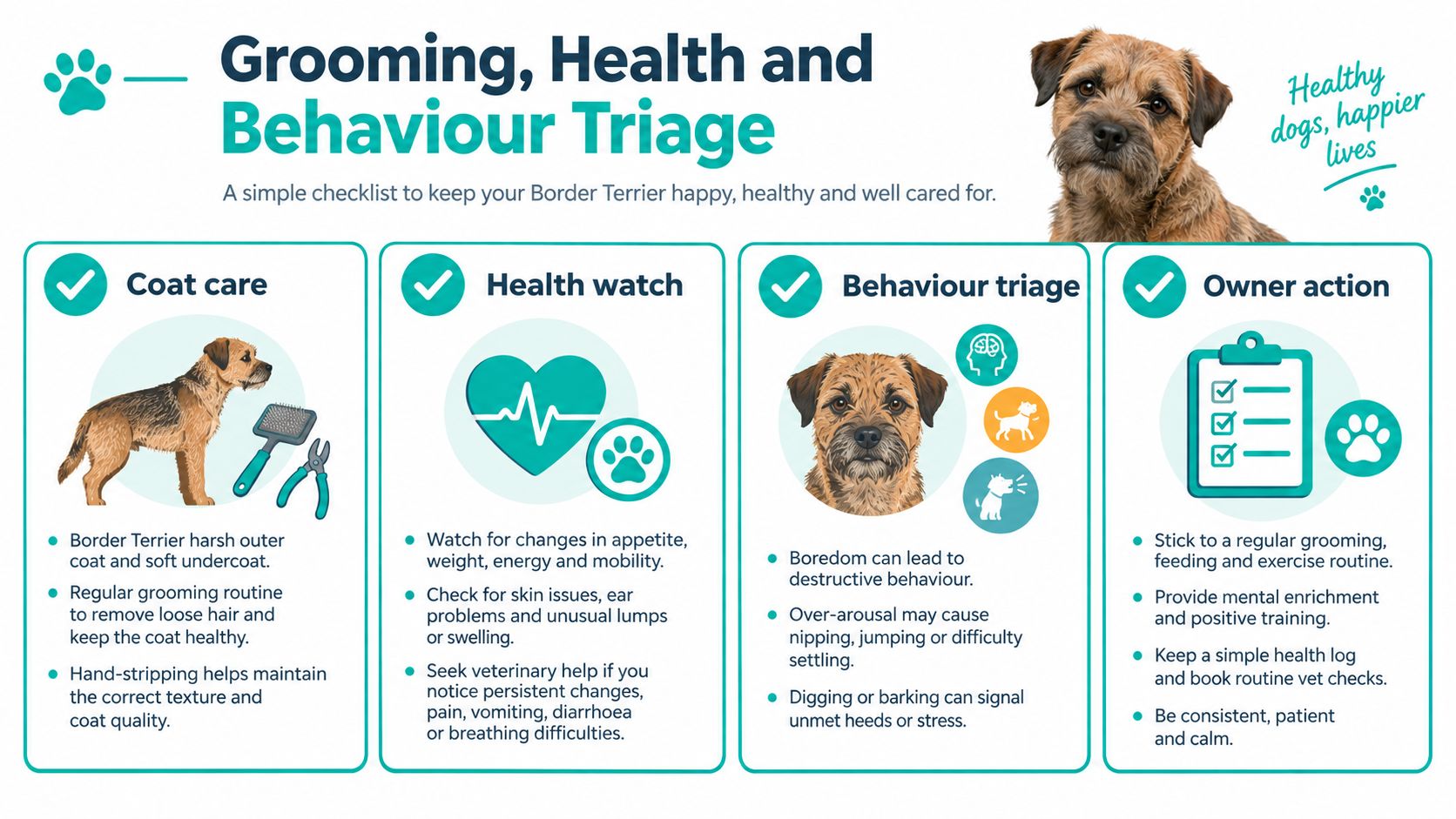
Coat is the first practical split. A Border's harsh outer coat and soft undercoat protect in poor weather, but the texture needs proper maintenance to keep doing that job. Ask the breeder or groomer about hand stripping, coat rolling and how often they expect the coat to need attention. A Jack Russell coat is usually less involved, yet mud, seeds and parasites still need checking after rural walks.
Don't skip the boring checks. Teeth, ears, nails, skin and body condition should be handled from puppyhood so a vet examination isn't a wrestling match. Parasite prevention belongs in the same routine, and our flea and tick prevention guide for the UK sets out the questions to ask your practice.
Health Claims Need Evidence, Not Sales Copy
Breed cross listings mention conditions including patellar luxation, eye disease, epilepsy and deafness, but a list alone doesn't tell you an individual puppy's risk. Ask what screening the parents have had, ask to see paperwork, and ask your vet how they'd verify it. A cross isn't automatically healthier, and a pedigree isn't automatically fragile. Evidence beats the label every time.
PDSA describes Jack Russells as highly active, prone to barking and potentially vulnerable to separation anxiety, recommending at least an hour of daily exercise, mental stimulation and avoiding solitude beyond four hours, in its PDSA Jack Russell Terrier care advice. Use that as a welfare baseline, not as a diagnosis for every noisy dog.
When More Exercise Is the Wrong Answer
- See your vet first: Sudden barking, reactivity, restlessness or nipping can involve pain, ear or dental discomfort, or another clinical problem.
- Track the trigger: Note time, place, people, dogs, noises and what happened just before.
- Reduce rehearsal: Manage fences, windows and greeting routines while you get advice.
- Ask for referral: Escalating fear, frustration or separation distress may need a qualified clinical behaviourist after veterinary assessment.
Longer walks can help an under stimulated dog. They can also wind up an over aroused, sore or frightened one.
Budget accordingly. Behaviour support may involve consultations, diagnostics, medication and follow up, not one training class and a new harness. Catching the distinction early is kinder and usually cheaper than spending months exercising a problem that needed clinical eyes.
What a Terrier Really Costs Across Its Life
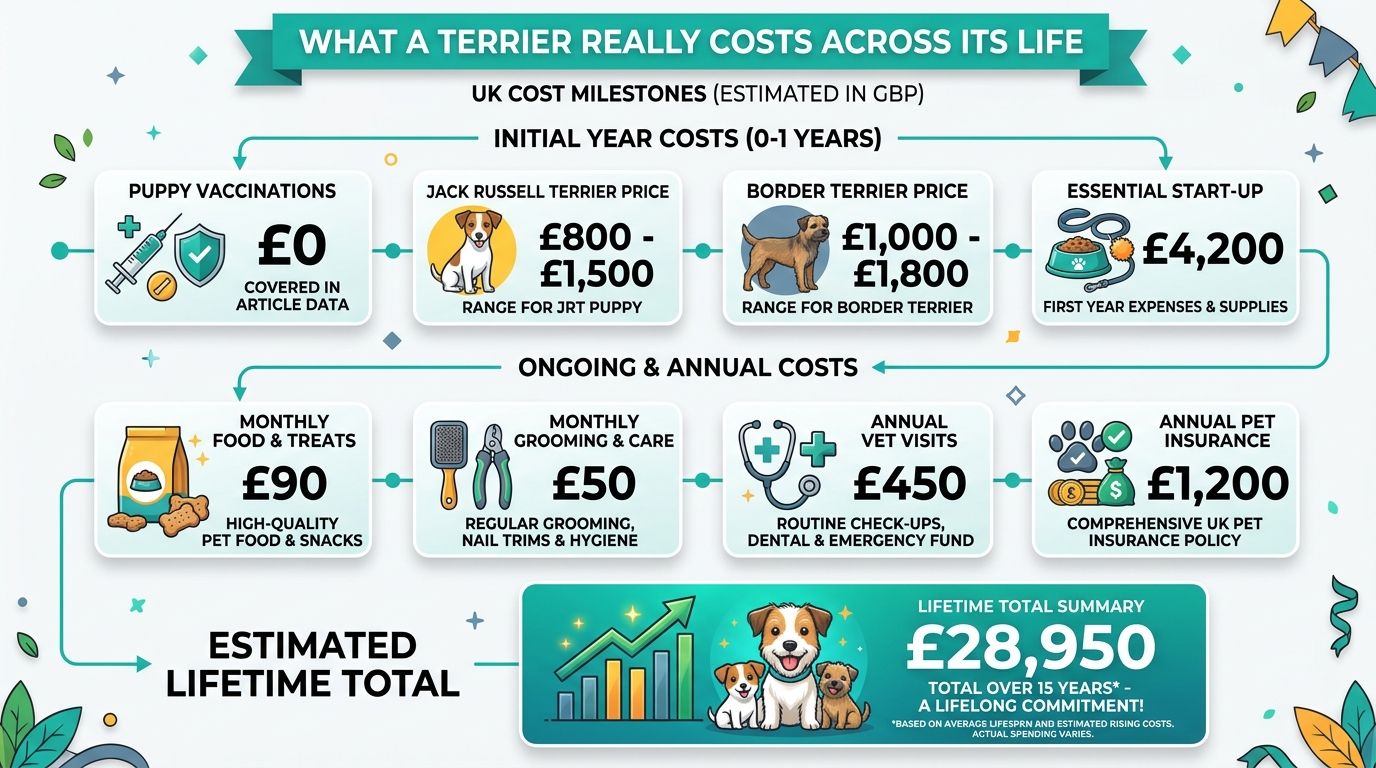
Small food bills mislead people. Veterinary care doesn't scale down neatly with body weight. A consultation, an anaesthetic, dental work, imaging or an emergency appointment still involves staff time, facilities, medication and follow up. That's why I won't give you a fixed lifetime figure for a Jack Russell Border Terrier cross. Anyone who does is guessing with your money.
PDSA lists the Border Terrier at 25 to 28 cm, 5 to 7 kg and a lifespan of over 12 years, recommending at least one hour of exercise every day, ideally split between two walks with some off lead activity in a secure area, in its PDSA Border Terrier care advice. Read that lifespan properly. You're not budgeting for a puppy. You're budgeting for well over a decade of routine care plus the senior years.
Map the Cost Points Before They Arrive
- Puppy stage: Vaccinations, microchipping, parasite control, socialisation classes and neutering discussions.
- Active adult years: Dental checks, weight management, cuts and strains from chasing, digging or squeezing through gaps.
- Behaviour support: Training, vet checks and possible referral if problems escalate.
- Senior years: More frequent checks, mobility and dental issues, medication and diagnostics.
- Emergencies: Out of hours consultations and treatment that can't wait for a routine slot.
Time is a cost too. The Border's walking minimum sits alongside play, training and free time, and the Jack Russell side can push activity higher. If you need a dog walker to cover workdays, price that into the breed decision now, not after the puppy arrives.
For money you can compare like for like, use our own pricing data by postcode and look at itemised routine fees rather than a vague national average. Prices change with practice, consultation type, medication, anaesthesia and follow up. Our comparison of pet insurance versus paying out of pocket helps you decide how to carry the risk, but it won't remove it. Either you insure carefully, you save deliberately, or you're relying on luck. Luck is not a plan for an athletic terrier.
Choosing Between the Two for Your Situation
Start with your postcode and your calendar, not with photos. UK wide evidence in the 2025 PDSA PAW mini report shows 51% of pet owners worry about affording veterinary care, while 23% would use savings and 15% a credit card for an unexpected bill. It puts the UK dog population at 11.1 million and reports that more than two fifths of owners find ownership more expensive than expected. Don't become another surprised owner.
Match the Dog to the Home You Already Have
Flat with a secure local park: Either breed can work if exercise, toilet trips, barking management and alone time are realistic. A high intensity Jack Russell type is the harder neighbour risk.
Rural home with moorland access: The Border endurance profile usually fits beautifully, provided livestock control and recall are taken seriously. The Jack Russell type will love it too, but you'll manage hedge diving and holes.
Family home: Supervision matters more than breed marketing. Terriers can be affectionate and playful, but they're not tolerant of rough handling just because they're small. Teach children to leave a resting dog alone.
First terrier: I'd usually steer you towards the steadier Border profile over the sharpest Jack Russell type, and towards an adult rescue whose character is known over a cross puppy whose adult profile is still unwritten.
The cross specifically: Choose it because you met the parents, liked their health evidence and can cope with either outcome. Don't choose it because an advert promises the best of both breeds. It may also deliver the coat care of one and the intensity of the other.
Before you reserve a puppy, compare local routine fees. The Vet Price Comparison Site offers postcode based search with side by side comparison of consultation, vaccination, neutering and microchipping fees, county pricing maps and practice profiles sourced from publicly available RCVS data. It operates independently with no referral commissions, so you can use the displayed itemised figures as a starting point and then confirm details with the practice.
My verdict is direct. Pick endurance if your pleasure is long walks in all weather. Pick sprint and problem solving if training games are your hobby. If you want a quiet, low cost, easy small dog, pick neither.
Practical Next Steps Before You Commit
Do these in order. First, get the parents' actual height, weight, coat type and health screening paperwork. Second, write out your weekday routine and check it delivers at least an hour of purposeful activity plus training and rest. Third, secure the garden and plan long line recall work before you dream of off lead freedom.
Fourth, price the first year locally, including vaccinations, microchipping, parasite control and neutering. Our guide to your first vet visit and what to expect will help you prepare questions. Finally, if behaviour changes suddenly, book a vet before adding miles. A cross isn't automatically cheaper to treat or insure. What matters is the individual dog, the practice and the care required.
Search your postcode on The Vet Price Comparison Site to compare itemised consultation, vaccination, neutering and microchipping fees from practices near you before your terrier arrives. Use those real local figures to build a first year budget for a Jack Russell, a Border Terrier or their cross, rather than relying on guesswork or a national average.