Rabbit vet costs in the UK vary widely between practices, with a combined rabbit vaccination listed at £79 by one practice and £81 by another, while a rabbit spay ranges from £140 to £231. Those gaps matter because the headline fee rarely tells you what you'll pay once consultations, health checks, hospitalisation and follow-ups are added.
You're probably here because your rabbit needs something soon, a vaccination, neutering, or a check because they've stopped eating properly, and two practices have quoted numbers that don't match. That's normal in the UK. It doesn't mean one is automatically better value. It means you need to compare the whole pathway, not the first price you see.
Table of Contents
- Why Rabbit Vet Costs Vary So Much Across the UK
- What a Rabbit Consultation and Vaccination Actually Include
- Comparing Routine Rabbit Fees Between UK Practices
- The True Cost of Rabbit Neutering and Surgery
- Planning for Dental and Emergency Rabbit Treatment
- Where Rabbit Insurance Helps and Where It Falls Short
- How to Compare Local Rabbit Vets and Control Costs
Why Rabbit Vet Costs Vary So Much Across the UK
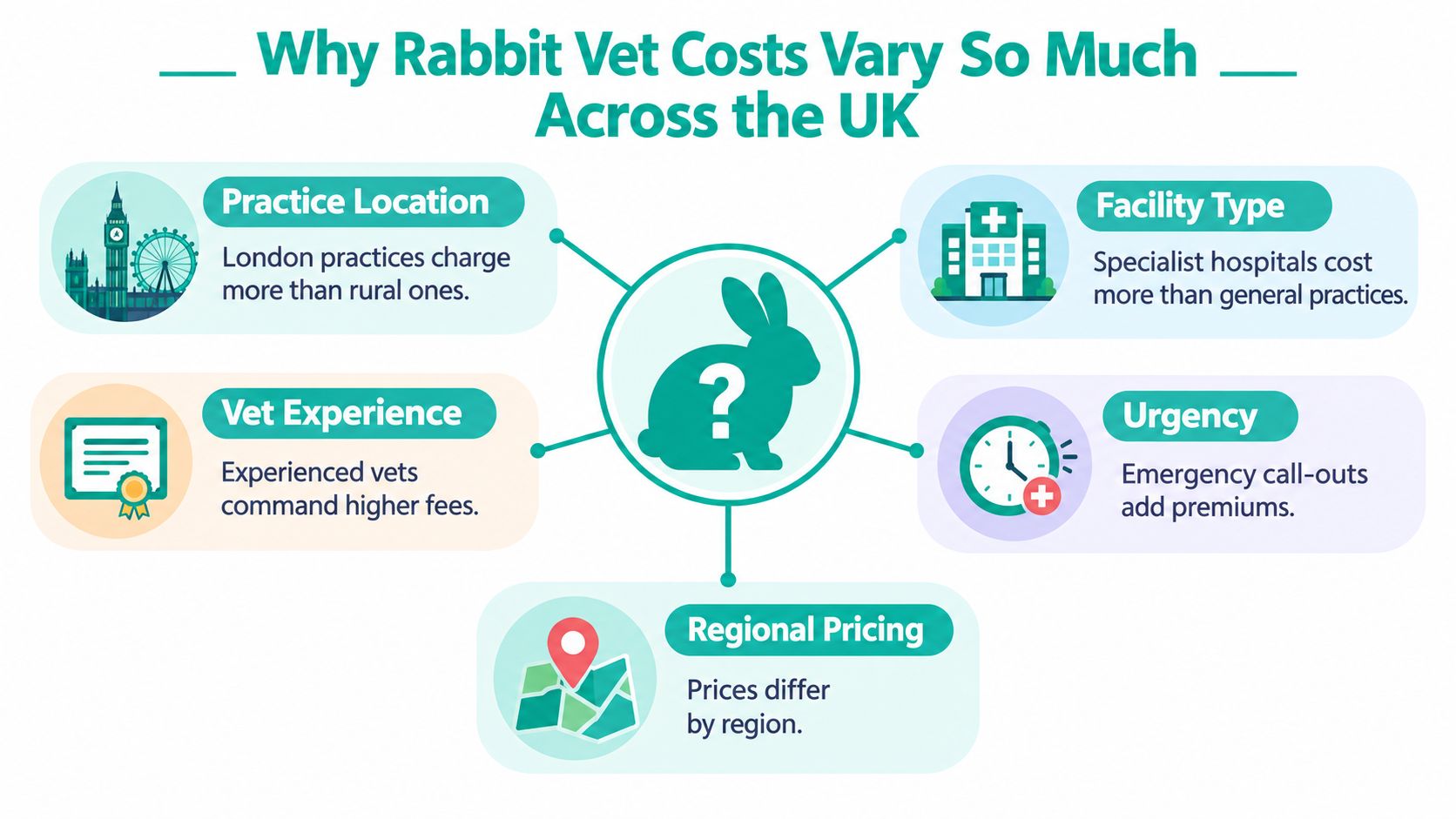
Stop looking for a standard UK price for rabbit care. There isn't one. The Royal College of Veterinary Surgeons guidance on fees and pricing states that veterinary practices are private businesses and set their own prices, with no statutory or fixed charges for veterinary services in the UK. Two practices on neighbouring streets can charge differently for what looks like the same appointment, and they're both allowed to do so.
That freedom isn't the problem. Opaque bundling is. One practice folds the consultation into the vaccination fee. Another lists them separately. One neutering quote includes overnight hospitalisation and pain relief. Another covers the operation itself and adds the rest later. If you compare headline numbers without checking inclusions, you'll pick the wrong practice on price and still feel surprised at the desk.
The Mental Model That Actually Helps
Think of every rabbit bill as a bundle with movable parts. The consultation, any pre-operative check, anaesthetic, medication, hospitalisation, diagnostics, follow-up visits and VAT can each sit inside or outside the advertised figure. Your job isn't to memorise prices. It's to ask, for any quote, which of those parts you're paying for and which you'll be charged for separately.
Location and practice type shape the starting point before you even discuss treatment. A university hospital, a referral centre and a small independent first-opinion practice carry different staffing, equipment and overheads, so their fee structures differ. Rabbit-specific experience matters too, because handling, examining and anaesthetising a rabbit isn't the same work as a routine dog appointment. None of that justifies a vague quote, but it does explain why identical wording on two price lists can describe different levels of service.
Practical rule: Never compare two rabbit quotes until you've confirmed both cover the same inclusions. A cheaper consultation that excludes everything else is often the more expensive episode.
Urgency changes the picture further. Care during normal hours and care provided through an emergency provider are priced under different structures, sometimes by a different team entirely. That's why a practice that looks affordable for a Tuesday morning check can still leave you exposed on a Sunday night. Wider patterns in our UK vet pricing data report for 2026 reinforce the same point, published fees only become useful when you read them locally and line by line. Use national commentary for context if you like, but make your decision from itemised, local figures.
What a Rabbit Consultation and Vaccination Actually Include
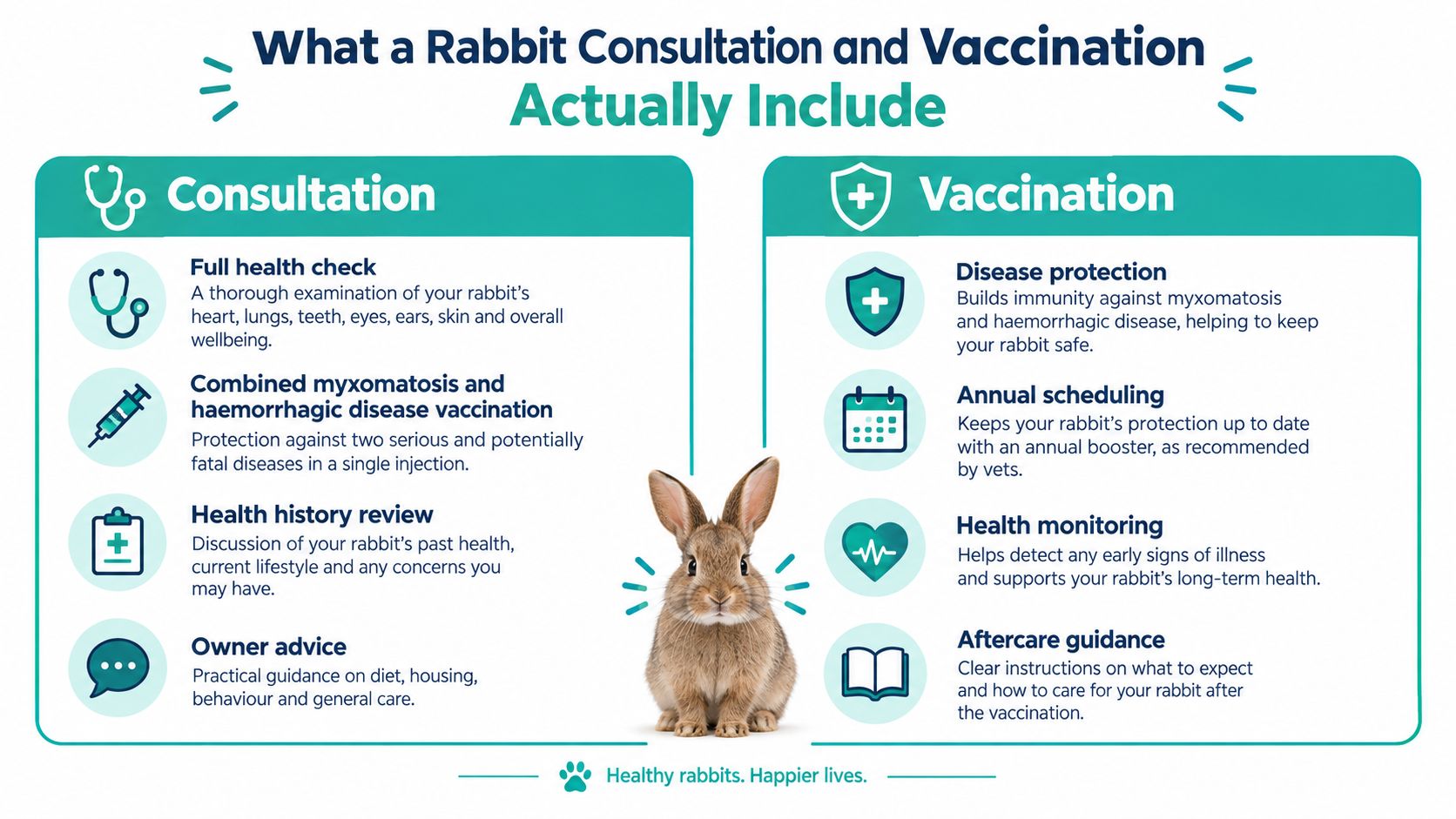
A rabbit consultation isn't just ten minutes in a room. A good vet starts with history, appetite, droppings, water intake, behaviour, weight change, diet and housing, because rabbits often go quiet rather than showing obvious distress. The examination then covers weight and body condition, heart and lungs, the abdomen, skin, ears and teeth, with particular attention to dental wear. You're paying for that interpretation as much as the hands-on check, especially in a prey animal that masks pain.
The fee normally stops at examination and advice. Dispensed medicines, laboratory work, imaging and later rechecks are commonly charged on top. That's not a trick, but owners who assume the consultation price covers treatment get caught out. Ask at booking whether follow-up advice is included, whether minor handling is part of the appointment, and how the practice charges if the vet wants tests.
Where Vaccination Pricing Gets Misleading
Vaccination is where bundling confuses people most. The Royal Veterinary College published price list lists a combined annual myxomatosis and haemorrhagic disease rabbit vaccination at £81 including the consultation, and notes a new patient not seen in the previous six months may need an additional £58 health check before booking. That single condition changes a first visit completely. An established patient pays the bundled figure. A new patient may pay the health check first, then the vaccination appointment.
Read that carefully before you ring round for quotes. If another practice quotes a similar vaccination figure but doesn't require a separate pre-booking check, the actual first-visit totals aren't similar at all. If it quotes the vaccine alone and adds a consultation, the same problem appears in reverse. Our guide to what vaccinations your pet needs helps with scheduling, but scheduling doesn't answer the pricing question. You still need the practice to confirm what's bundled.
- Ask which diseases are covered: Confirm the vaccine components included in the quoted appointment, rather than assuming every combined product is identical.
- Ask if the examination is included: A vaccination visit that includes a full health check isn't comparable with an injection-only price.
- Ask about new patient conditions: Check whether a separate health check is required before the practice will book the vaccination.
- Ask about VAT and records: Confirm the final payable figure and bring previous vaccination records so you don't pay for unnecessary repetition.
Don't treat a small headline gap as a saving until you've answered those four questions. In rabbit vet costs UK searches, owners fixate on a couple of pounds difference and miss a separate check that wipes it out several times over.
Comparing Routine Rabbit Fees Between UK Practices
Put two real published price lists side by side and the pattern becomes obvious. Vaccination can look almost identical while other routine fees diverge sharply. That tells you something useful, practices don't price every service with the same margin or the same inclusions, so you can't judge a practice's overall value from one line.
The Royal Veterinary College and Towcester Vets illustrate this well. Their combined vaccination figures sit close together, yet their consultation and neutering prices don't. Part of that gap reflects what's included, particularly consultation bundling and hospitalisation, and part reflects different fee structures entirely. Neither list alone proves which practice suits your rabbit. Together, they show you what questions a serious comparison must answer.
Published Routine Rabbit Fees at Two UK Practices
| Service | RVC published fee | Towcester published fee | What is included |
|---|---|---|---|
| Combined myxomatosis and haemorrhagic disease vaccination | £81 | £79 | RVC figure includes the consultation. Confirm Towcester bundling directly before booking. |
| Rabbit consultation | Check current list for the applicable consultation category | £38 | Towcester lists a separate rabbit consultation fee. RVC may require a separate health check for some new patients. |
| Male castration | £189 | £110 | RVC figure includes overnight hospitalisation. Confirm anaesthetic, pain relief and follow-ups on both quotes. |
| Female spay | £231 | £140 | RVC figure includes overnight hospitalisation. Confirm pre-op checks and post-operative care on both quotes. |
The numbers in that table are provider-published figures and can change over time, so always recheck before booking. Even allowing for that, the structure is the lesson. A £2 vaccination gap tells you almost nothing. A consultation listed separately at one practice and bundled at another changes the comparison. Neutering gaps need a fuller breakdown, which is covered in the next section, because surgery bundles vary more than vaccination bundles.
Don't ask a practice, "How much is a rabbit vaccination?" Ask, "What's the total I'll pay at that visit, including the examination and VAT?"
Postcode-level comparison works because it forces that discipline. You're looking at practices you can reach, checking whether they treat rabbits or small mammals, and reading the exact service lines you'll use. A distant cheap quote you can't reach in an emergency has limited value. A slightly higher local quote with clear inclusions, rabbit experience and published emergency arrangements may be the better financial decision over a year of care.
One more warning. Some practices list rabbits under small pets, small mammals or exotics rather than a dedicated rabbit heading. If you search only for the word rabbit, you'll miss relevant fees and wrongly conclude a practice doesn't publish them. Read the category wording, then ring and confirm. Five minutes on the phone beats an incorrect assumption built into your budget.
The True Cost of Rabbit Neutering and Surgery
Neutering is the largest planned expense most owners face, and it's where headline pricing misleads most aggressively. A female spay is abdominal surgery, with more surgical access and monitoring than a male castration, so the two operations shouldn't share one price and shouldn't be compared as if they're interchangeable. Sex, anaesthetic protocol, monitoring, hospitalisation and aftercare all move the total.
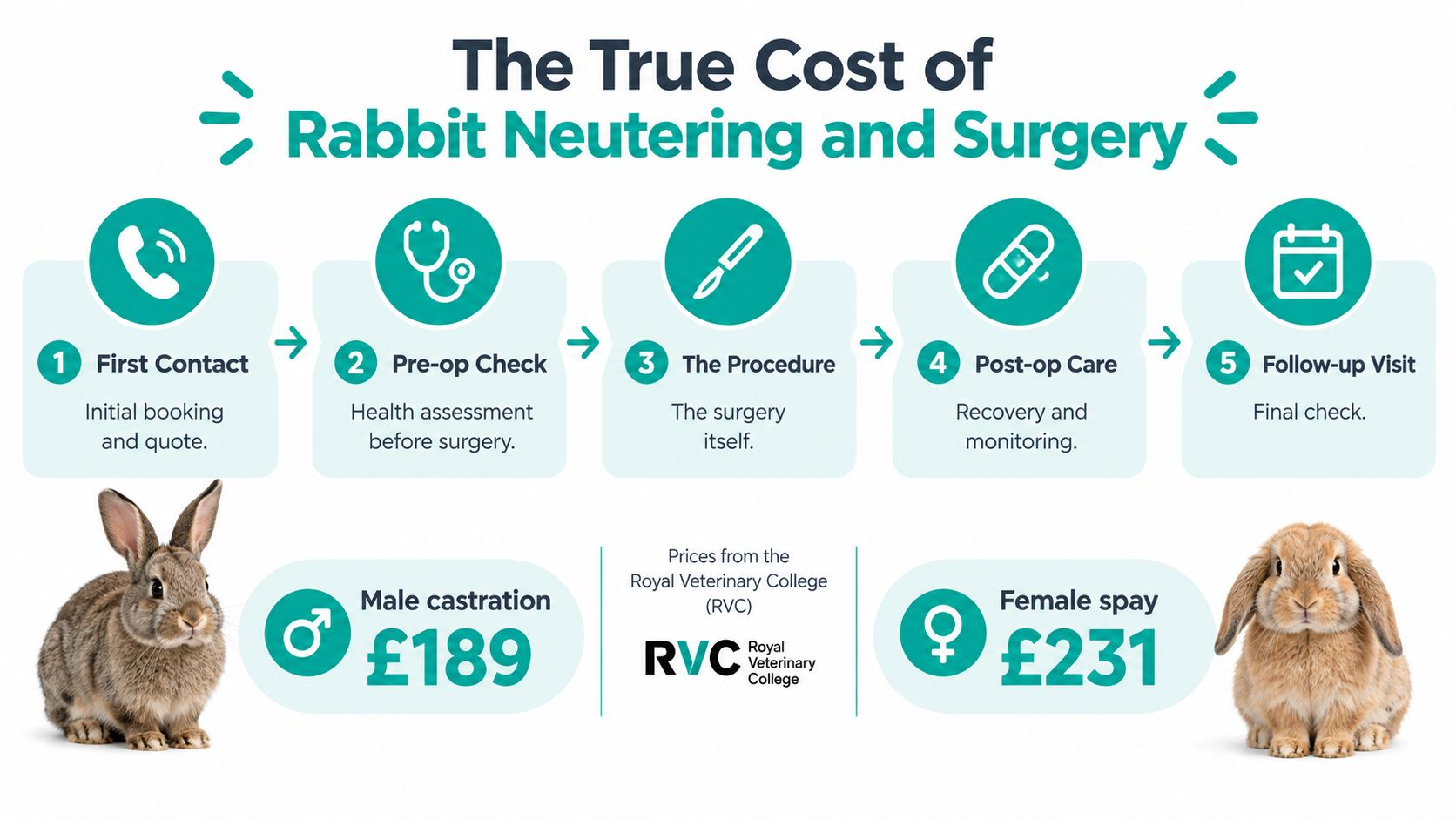
Start with the published gap. The RVC lists £189 for male castration and £231 for a female spay, with overnight hospitalisation included. Towcester lists £110 for castration and £140 for spaying. That's a £79 difference for castration and £91 for spaying before you examine what's bundled. If you stop there, you'll assume one practice is cheaper. You don't know that yet.
Trace the Whole Pathway Before You Decide
Work through the pathway in order. First contact and booking may trigger a pre-operative health check, particularly if the practice hasn't seen your rabbit recently. At the RVC, a new patient who hasn't been seen in the previous six months may need that additional health check mentioned earlier, taking the potential total to £247 for castration or £289 for spaying. That's not a hidden charge if you read the list properly, but it is routinely missed by owners comparing operation prices alone.
Next comes the procedure itself, anaesthetic, surgical time, monitoring and pain relief. Then recovery, which may mean same-day discharge or overnight hospitalisation. Then discharge medication and one or more post-operative checks. A lower headline figure that excludes pre-op assessment, pain relief at home or the recheck will narrow quickly once those items are added. A higher all-inclusive figure may be easier to budget for, even if it looks worse in a table.
- Pre-operative check: Is it required, is it included, and does recent attendance change the answer?
- Anaesthetic and pain relief: Are both bundled, including medication to take home?
- Hospitalisation: Does your rabbit stay overnight, and is that stay in the quoted price?
- Follow-up care: How many post-operative checks are included, and what happens if complications arise?
- Written estimate: Does it cover likely charges, possible complications, follow-up care and VAT before you agree to non-emergency treatment?
Don't choose rabbit surgery on price alone. Rabbit anaesthesia and recovery need appropriate experience, calm handling and a team comfortable with small mammals. Ask the practice to explain its rabbit protocol in plain language. If a practice can't itemise the quote or won't explain aftercare, that's information too, and not reassuring information. Pay for clarity and competence. Save money by comparing complete pathways, not by hunting the lowest operation-only number.
Planning for Dental and Emergency Rabbit Treatment
Routine fees are manageable because you can schedule them. Dental disease and gut stasis don't work that way. They recur, they escalate quickly, and they turn a tidy annual budget into a series of unplanned bills. If your financial plan for rabbit vet costs UK wide covers vaccination and neutering but nothing else, you don't have a plan. You have a best-case scenario.
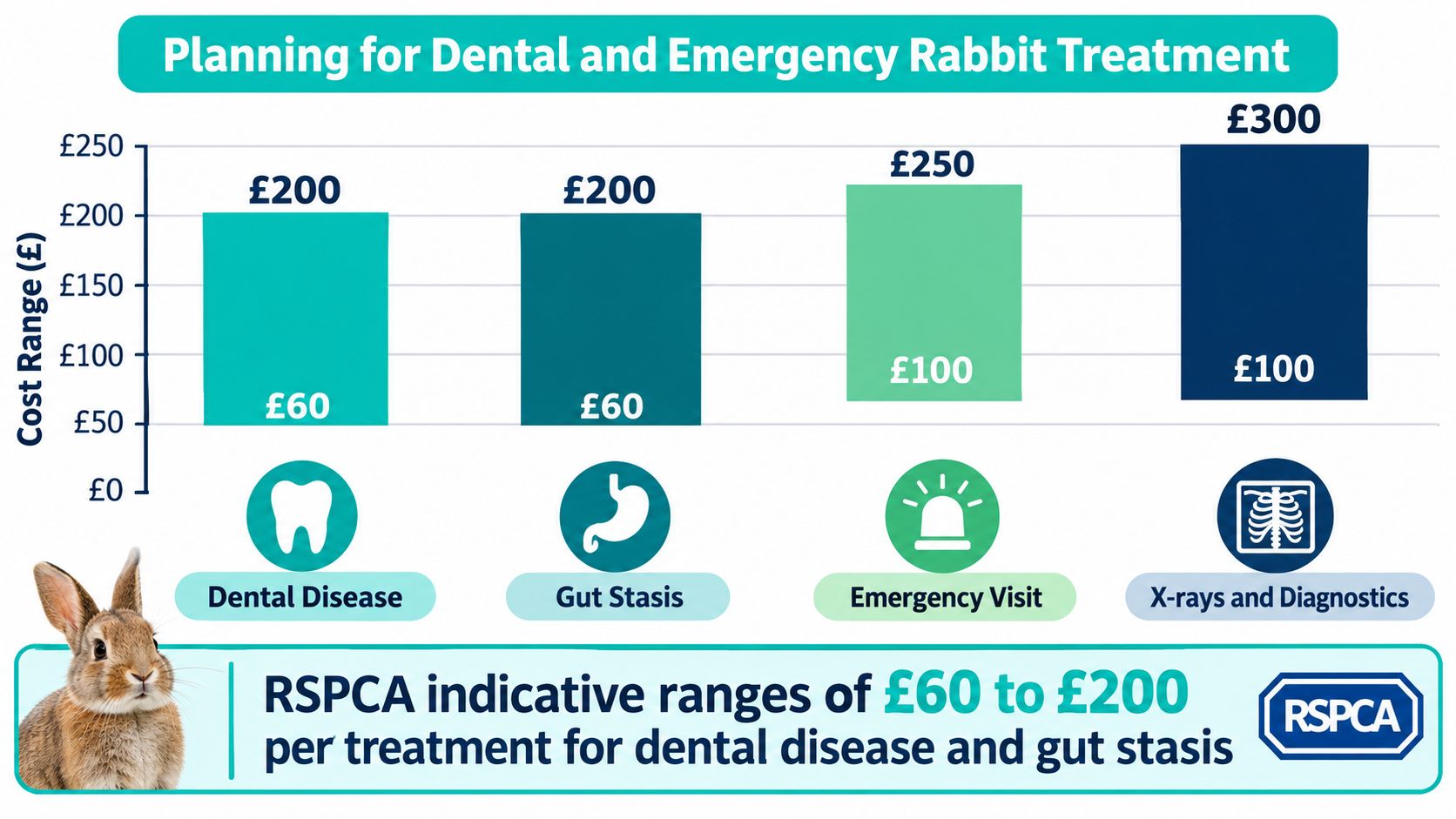
Use indicative ranges to build a reserve, then check local fees for the items you can verify. The RSPCA guidance on costs and time involved in keeping rabbits.pdf/9eb4863e-5061-8488-3909-9324433fd670?version=2.0&t=1559127982853&download=true) puts dental treatment at £60 to £200 per episode, with chronic dental cases sometimes requiring treatment every four to eight weeks, and gut stasis treatment at £100 to £300 including medicines and X-rays. Read the dental frequency again. A single episode at the bottom of that range is annoying. Repeated episodes across a year become one of your largest ownership costs.
Build Two Budgets, Not One
Separate predictable care from contingency money. Put consultations, vaccination and planned neutering in the first pot, priced from practices near you. Put dental episodes, gut stasis, diagnostics, hospitalisation, assisted feeding and rechecks in the second. That separation matters because general ownership estimates routinely exclude illness. The RSPCA estimates annual ownership costs at £1,047 for one rabbit and £1,550 for a pair, excluding veterinary treatment for illness, injury or disease. Owners who treat those totals as all-in budgets underfund the exact problems rabbits commonly develop.
Act early when appetite or droppings drop. A rabbit that stops eating isn't a wait-and-see budgeting decision, and delay can turn a consultation-led treatment into hospitalisation. Unlimited hay, weight tracking at home and prompt attention to reduced output won't eliminate dental or gut problems, but they're sensible, low-cost habits that support earlier detection. Money saved by delaying care for a deteriorating rabbit is usually spent later, with worse options.
Budget honestly: If you couldn't pay for an urgent episode this week without borrowing, your reserve isn't built yet, whatever your routine budget says.
Check your practice's emergency arrangements before you need them. Save the out-of-hours number, confirm where you'd travel, and ask how estimates and staged decisions work once the initial examination is done. Our guide to emergency vet costs in the UK covers the questions to prepare in advance. Do that preparation on a calm day. You won't compare fees well at midnight with a hunched, silent rabbit in a carrier.
Where Rabbit Insurance Helps and Where It Falls Short
Insurance doesn't solve rabbit affordability. It solves part of it, for some events, under specific wording. Owners who buy a policy and stop comparing routine prices have misunderstood what they've purchased. Predictable, recurring rabbit care is exactly where many policies help least.
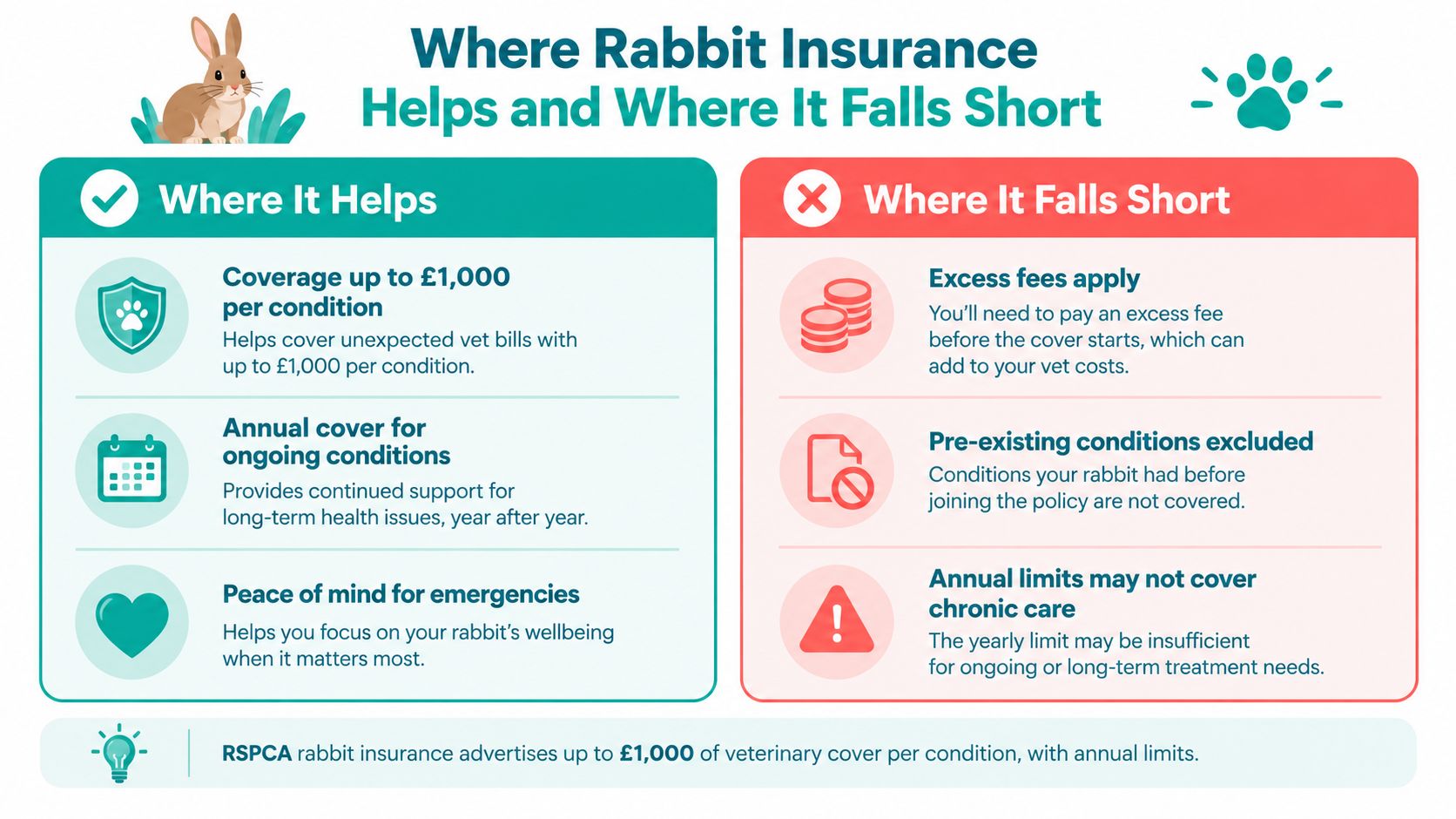
Look at the gap between marketing and exclusions. The RSPCA rabbit insurance page advertises up to £1,000 of veterinary cover per condition with annual renewal, but its policy documentation excludes routine and preventative treatments, vaccinations, spaying, castration and cosmetic dentistry. That's not a minor footnote. Vaccination and neutering are planned costs you'll almost certainly face, and you'll face them outside the policy.
Run the Break-Even Test Yourself
Don't ask whether insurance is worth it in the abstract. Compare the annual premium plus excess against realistic scenarios for your rabbit. One emergency episode, repeated dental management, or ongoing gastrointestinal care each test a policy differently. Check waiting periods, pre-existing condition exclusions, per-condition limits, annual caps and how dental work is defined. The distinction between illness-related dentistry and routine or cosmetic dentistry can decide whether a claim succeeds, so read the exact wording rather than the summary panel.
Insurance can still earn its place. It can reduce the financial shock of a major insurable illness or accident and give you more room to agree to diagnostics without pausing over every line. That's valuable. It just doesn't replace price comparison for the care excluded from cover, and it doesn't remove the need for accessible cash while you pay upfront or cover an excess.
- Cover limit: What's the maximum per condition, and does it renew annually?
- Exclusions: Are vaccinations, neutering and dental categories excluded, and in what words?
- Excess and caps: What do you pay first, and what ceiling applies across the year?
- History: How are pre-existing conditions and waiting periods handled?
Our comparison of pet insurance versus paying out of pocket is useful for that decision, but apply it with rabbit-specific scepticism. The strongest position for most owners is combined, insurance or a reserve for major shocks, plus deliberate local comparison for every routine fee insurance won't touch. One without the other leaves a hole.
How to Compare Local Rabbit Vets and Control Costs
Start with your postcode, not a national average. List practices you can realistically reach, confirm they treat rabbits or small mammals, then compare consultation, vaccination, neutering and emergency access as separate lines. The Vet Price Comparison Site lets you search by postcode and view published fees side by side, which is one practical way to build that shortlist without ringing every practice for a first quote.
Transparency is something you're entitled to use. The RCVS supporting guidance on practice information, fees and animal insurance states clients should receive sufficient information about fees, medicines, relevant procedures and tests to make informed choices, and practices should publish information about the initial cost and location of 24/7 emergency first aid and pain relief. If that information isn't visible, ask for it directly.
Your Pre-Booking Checklist
- Confirm the total: Ask what you'll pay if everything is routine, including VAT.
- Confirm inclusions: Consultation, anaesthetic, pain relief, hospitalisation, medication and rechecks, item by item.
- Confirm emergency access: Provider, location and initial emergency cost.
- Get it in writing: Request a written, itemised estimate before non-emergency work.
- Recheck prices: Published fees change, so verify them again before booking.
Those steps take minutes and prevent most invoice surprises. For broader habits that cut waste without cutting care, read how to save on vet bills, then apply the checklist to your two nearest suitable practices today. Don't guess from averages. Compare complete, local pathways and keep the paperwork.
Stop guessing what your rabbit's next appointment should cost and compare published consultation, vaccination and neutering fees from practices near your postcode instead. The Vet Price Comparison Site brings those local prices together side by side so you can check inclusions, shortlist rabbit-friendly practices and budget with real figures. Visit today, run your postcode search, and book your next rabbit appointment knowing exactly what you're comparing.