A typical UK budget for a dog CT scan with a written report is around £1,000–£1,700, while multi-region or urgent cases can exceed £2,000. The final figure depends on the body area, anaesthesia, contrast and reporting, so the headline scan price alone won't tell you what the whole diagnostic episode costs.
The popular advice to “get a few quotes” only helps if you compare the same things. One estimate might cover a scan alone; another may include the checks, anaesthesia and interpretation needed to make the images useful. Ask what each price buys before deciding which is cheaper.
Table of Contents
- What a Dog CT Scan Costs in the UK
- Why Quotes Differ and What Each Line Covers
- When Vets Recommend a Dog CT Scan
- How a Dog CT Scan Works Step by Step
- Alternatives to CT and When They Cost Less
- Get an Itemised Estimate Before You Book
What a Dog CT Scan Costs in the UK
The headline scan price is the least useful number on a quote. What matters is the full diagnostic episode: the scan and any associated care or interpretation needed for the results to be useful. Costs vary between practices, and the same line item may be included in one quote but listed separately in another.
| Cost element | What it covers |
|---|---|
| Single body region scan | One area examined under anaesthesia or sedation. Check what the quoted scan fee includes. |
| Additional body region | Each extra area examined in the same session. Ask whether this is priced separately or included in a package. |
| Contrast medium | Iodine-based dye used to show blood vessels and tissue detail. Confirm whether it is needed and included. |
| Specialist written report | A radiologist's interpretation and written report. Check whether the report is part of the quote. |
| Faster or urgent reporting | A shorter wait for the written report. Ask whether a faster turnaround changes the total. |
| Full-body or multi-region package | Several areas included in one quote. Compare which regions and services the package covers. |
Treat the rows as possible parts of an estimate, not a national price list. The RCVS guide to veterinary fees and pricing explains that veterinary fees are not nationally fixed. A UK veterinary pricing data report offers wider context, but it cannot tell you what a particular practice will charge for your dog's planned scan.
A quote is easier to judge when each line has a clear job. The scan fee covers imaging of specified areas; other lines may cover contrast, anaesthesia, blood tests or interpretation. Before booking, ask which of these are included, which may be added, and whether the written report is part of the total. That way, you compare the cost of the whole diagnostic episode rather than scanner time alone.
Why Quotes Differ and What Each Line Covers
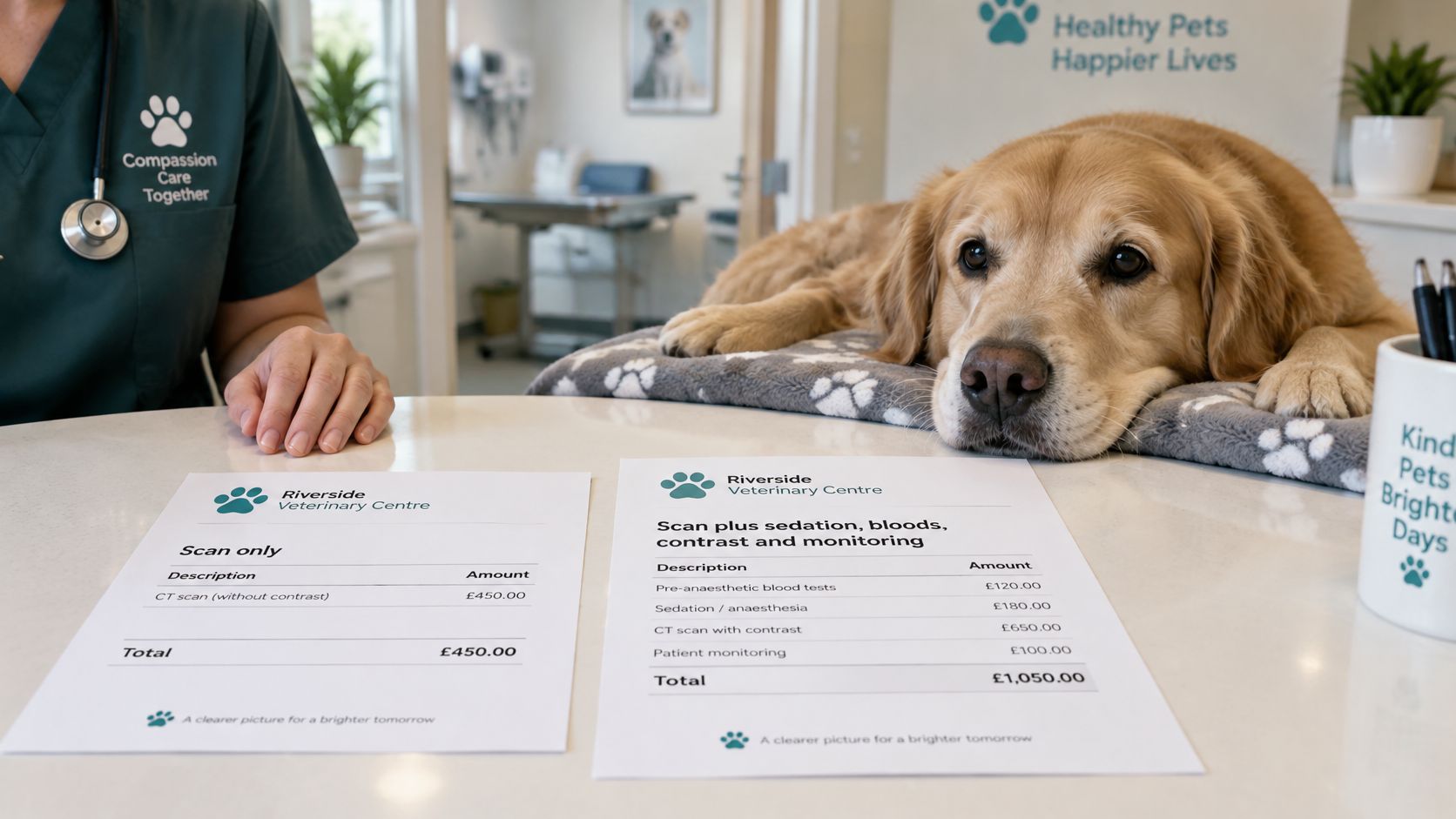
Two quotes arrive for the same dog. One has a much lower headline price; the other costs more but lists sedation, blood tests, contrast, monitoring and a written report. Before treating the first as a bargain, check whether both estimates cover the same diagnostic work.
UK practices set their own fees. The RCVS guidance on veterinary fees states that veterinary charges aren't statutory and are primarily negotiated between the practice and the client. The final price can reflect the practice and location, the area examined, how urgently results are needed, and what care surrounds the scan. The RCVS advises owners to ask about fees and payment arrangements before treatment, which is why an itemised estimate is more useful than a headline figure.
Consider how you would shop for a car. The base price isn't the price of a version with every feature you'll use. Similarly, a scan-only fee and a package including anaesthesia, monitoring and interpretation may be for different services.
Three assumptions that make quotes hard to compare
A scan isn't automatically the same wherever you go. The number of body regions, use of contrast and reporting arrangements can differ. A higher quote doesn't necessarily mean the practice has a better or worse scanner, and the lowest headline price doesn't necessarily mean the lowest total cost of care.
Ask the practice to clarify each of these points:
- Consultation: Is the initial consultation included, or charged separately?
- Bloodwork: Are pre-anaesthetic blood tests included in the estimate?
- Anaesthesia and monitoring: Does the price cover sedation or general anaesthesia, monitoring and recovery?
- Contrast: Is contrast dye needed, and is it included?
- Interpretation: Who reads the images, and when will the written report be ready?
- Extra areas: How much does each additional body region add?
- Fluids and hospital stay: Are intravenous fluids or overnight hospitalisation included if needed?
- Aftercare: What follow-up appointments or medicines might add to the bill?
- Findings that need action: If the scan leads to a recommendation for biopsy or treatment, what would be quoted separately?
- VAT: Is VAT included in the estimate?
The RCVS guidance also supports asking for an itemised estimate that sets out likely additional charges and payment arrangements. For broader context on what fee information practices publish, see this guide to veterinary pricing transparency.
Practical rule: Put the same items in two columns, one for each quote. Mark every line “included”, “excluded” or “unclear”, then resolve the unclear lines before comparing totals from the first consultation to the written report.
When Vets Recommend a Dog CT Scan
A common reason for CT is chronic nasal disease, when the vet needs a closer view of structures inside the nose. CT provides cross-sectional images of bone and soft tissue, helping the veterinary team investigate what may be causing persistent symptoms and decide what to do next.
Your vet may consider other tests first. CT is most useful when the question needs detailed views of structures that aren't clear enough on a standard examination or X-ray, or when the images will help plan treatment. These are common examples:
| Clinical question | Why CT helps | Body area |
|---|---|---|
| Chronic nasal discharge or nosebleeds | Shows bone and soft tissue inside the nasal passages in fine detail | Head |
| Chronic or recurrent ear disease | Maps the middle and inner ear and the surrounding bone | Head |
| Suspected disc disease or spinal problem | Shows the spinal canal and bone detail that X-rays can miss | Spine |
| Chest or abdominal mass | Helps stage a tumour and checks lymph nodes and organs | Thorax and abdomen |
| Fracture or limb problem needing surgical planning | Gives a detailed bone view before surgery | Limb |
| Trauma or unexplained collapse | Provides a rapid screen for internal injury across several areas | Multi-region |
Each scan should answer a defined clinical question. A head scan for persistent nasal signs isn't interchangeable with imaging of the spine or a scan of the chest and abdomen. The body area affects both the information gathered and the scope of the quote.
Some situations are urgent, and delaying imaging to try less informative tests may not be the right choice. A referral to a specialist centre is common when detailed imaging or specialist interpretation is needed. If your vet recommends CT, ask for a plain explanation of what they're looking for and how the result could change the plan. They should be able to say, in one sentence, why CT is the next test for your dog.
For a separate example of how owners can assess the costs of a possible limb procedure, see this guide to dog cruciate ligament surgery costs in the UK. The purpose isn't to equate the procedures, but to help you plan questions about the wider care pathway.
How a Dog CT Scan Works Step by Step
The scanner may capture images quickly, but the appointment includes preparation, anaesthesia or sedation, recovery and a review of the results. The headline scan price is only one part of the cost of the diagnostic visit.
Referral and consultation: A vet examines your dog and decides whether CT can answer a question that other tests haven't resolved. The area to be scanned and the purpose of the scan help determine what the estimate needs to cover.
Pre-anaesthetic checks: The team may ask about your dog's health, examine them and recommend blood tests before sedation or general anaesthesia. Check whether those tests are included in the quote or charged separately.
Fasting and preparation: Follow the clinic's instructions about food and water, which can vary. If anything is unclear, call before the appointment rather than guessing.
Sedation or general anaesthesia: Dogs need to remain still to avoid blurred images. The type of anaesthesia, monitoring and recovery care all affect what the estimate may include.
Positioning and contrast: The team positions your dog on the scanner table. Contrast may be given through a vein to show blood vessels or tissue detail more clearly. Ask whether it is planned for your dog's scan and whether it is included in the price.
The scan itself: A CT scan typically takes 10–20 minutes, according to Donaldsons Vets' CT scanning information. The visit lasts longer because your dog needs preparation, monitoring and time to recover from anaesthesia.
Image review and results: A radiologist may interpret the images and send a report to your vet, who will discuss the findings and next steps with you. Ask when the results are expected and whether your dog will need to stay for monitoring.
Some quotes list each stage separately; others bundle several together. Check what the total includes, especially blood tests, anaesthesia, contrast, reporting and recovery care. That tells you more about the cost of the whole diagnostic episode than the scanner charge alone.
Alternatives to CT and When They Cost Less
A digital X-ray is often the first imaging test when a vet needs an initial look at bones, the chest or a suspected fracture. It can provide useful information at a lower cost than CT, but overlapping structures and limited soft-tissue detail can leave important questions unanswered.
| Option | Best for | Main limit | Cost relative to CT |
|---|---|---|---|
| Digital X-ray | First look at bones, chest and many fractures | Overlapping structures and limited soft-tissue detail | Lower |
| Ultrasound | Abdominal organs, heart and guided sampling | Can't see through bone or gas | Lower to similar |
| Blood and urine tests | Infection, organ function and metabolic causes | No structural picture | Lower |
| MRI | Brain, spinal cord and fine soft tissue | Longer anaesthesia and less widespread availability | Higher |
| Exploratory surgery | Cases where imaging can't answer the question | Invasive and carries surgical risk | Higher |
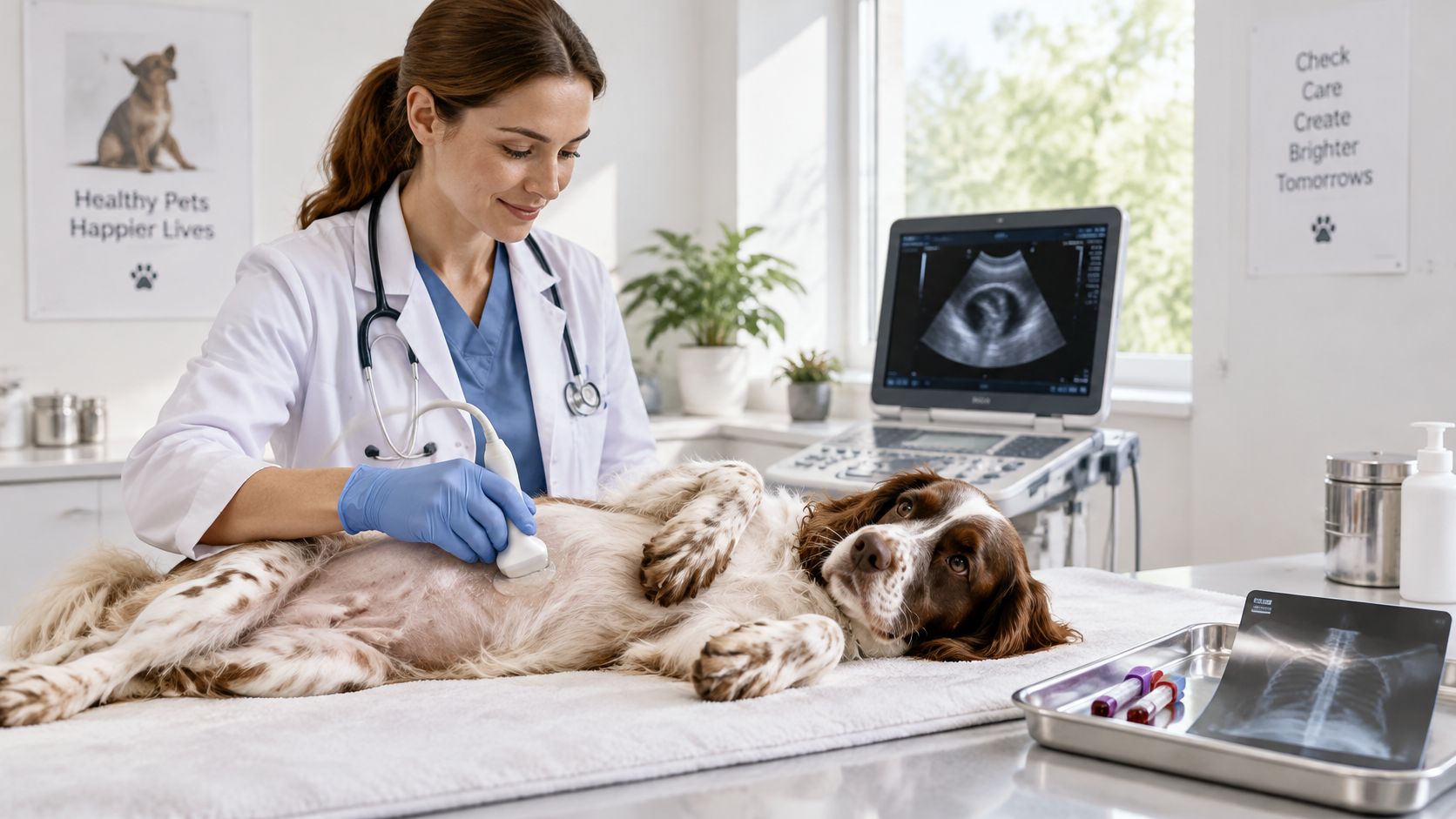
An ultrasound lets the vet examine abdominal organs and can help guide sampling, but it can't show structures through bone or gas. Blood and urine tests can help investigate infection, organ function or metabolic causes, though they don't produce an image of internal anatomy.
MRI and CT answer different questions. MRI is often chosen for the brain, spinal cord and fine soft-tissue detail; it generally costs more than CT and is less widely available, so it isn't usually the cheaper option. Exploratory surgery may be considered when imaging can't resolve the problem, but it involves an operation and its associated risks.
The sensible choice is the test that answers the clinical question, not automatically the cheapest or most advanced one. Your vet might recommend blood tests and an X-ray first, then decide whether CT is justified. If you're managing the wider cost of care, this guide to saving on vet bills can help you think through practical ways to plan.
Get an Itemised Estimate Before You Book
Before agreeing to a scan, use this routine to check what you'll pay for and what happens next:
- Request a written estimate. Ask the practice to list the body regions, contrast, anaesthesia, blood tests, report turnaround, hospitalisation and VAT.
- Check the extras. Mark each line as included, excluded or unclear, then ask the practice to explain anything you can't identify.
- Read your insurance policy. Diagnostic imaging may be covered, but your excess, annual limits and exclusions for pre-existing conditions affect what your insurer will pay. This guide to pet insurance versus paying out of pocket can help you weigh the options.
- Ask about payment options before the scan. If you may need instalments, raise it with the practice before the appointment.
- Check related local fees. The Vet Price Comparison Site lets owners compare published veterinary fees by postcode; use it to review nearby consultation or other listed charges, then ask the practice to confirm your CT-specific estimate.
- Clarify who will lead the case. Ask whether your first-opinion vet or a referral centre should coordinate the scan and follow-up, as the route can affect the overall plan.
If your dog needs emergency care, there may not be time to compare practices. Focus on stabilising your dog and request an itemised estimate as soon as it's practical.
The Vet Price Comparison Site lets you compare published veterinary fees by postcode and review local practice prices, helping you check related costs while you arrange your dog's scan. Visit The Vet Price Comparison Site to explore local pricing and plan the questions you'll ask your vet.